

Strategically Releasing Physical Music: An Indie Artist's Guide
You’ve poured your soul into your tracks, played countless gigs, and built a real connection with people who love your sound. Maybe you’ve started seeing comments pop up, or even DMs: "When can I get this on vinyl?" or "Any chance of a CD at your next show?" It’s a sign that you might be ready to make physical music. But this isn't about just making a cool collectible. A physical release is a business decision, and getting the timing and execution right is what turns it into a real source of income and a deeper connection with your fans.
How to tell if people will actually buy your music
Before you commit your hard-earned cash to pressing records or burning CDs, you need to know there’s a real audience for it. It’s easy to get excited about the idea, but you’re looking for concrete signals, not just hopeful hunches. Your audience will tell you if they want physical music, if you listen closely.
Start by paying attention to direct messages, comments on your social media posts, and even casual conversations after gigs. If someone specifically asks if you have physical copies of your latest EP, or says they’d love to own a vinyl of your most popular track, that’s a direct indicator. These aren't just compliments; they're market research. You can even run a quick poll on your Instagram stories: "If I pressed [Album Name] on vinyl, would you buy it?" The response rate can give you a clear picture.
Superfans are usually the first to signal this demand. These are the people who stream your music constantly, share your posts, and show up at every local gig. They’ve already invested emotional energy into your art, and often they’re looking for a tangible way to deepen that connection. A
craves deeper engagement and exclusive items.
Look at your existing merchandise sales, too. If you’re selling a good number of t-shirts or stickers, it indicates your fans are willing to spend money on physical items from you. Someone willing to buy a $25 t-shirt is often also willing to buy a $15 CD or a $35 vinyl, especially if it’s tied to music they love. If your non-music merch sells well, it’s a strong sign your fans are ready for more.
Why your live show is the best place to sell
Your live shows are, without a doubt, the most powerful place to sell physical music. There’s an energy at a show, a shared experience, that makes fans want to take a piece of it home. You’re right there, accessible, and they can support you directly. That personal connection translates directly into sales.
Think about the moment someone has just seen you pour your heart out on stage. They’re buzzing, feeling connected to your music in a way a stream can’t replicate. That's the perfect moment for them to pick up a physical reminder of that experience. You’re not just selling a CD; you’re selling a memory. This direct interaction at your merch table is often where you’ll see your highest profit margins.
Set up your merch table to sell more
Treat your merch table like a small shop, not just a place to stack boxes. Consider your touring setup and audience when choosing formats. CDs are fantastic for portability and affordability. They’re easy for fans to slip into a bag, and their lower price point makes them an easier impulse buy. If you’re playing smaller venues or traveling light, a stack of CDs is manageable.
Vinyl, on the other hand, is a premium item. It’s heavier, more expensive to produce, and commands a higher price, making it perfect for your most dedicated fans and collectors. If you’re playing larger shows or have a dedicated merch person, vinyl can be a huge draw. Make sure your display is clear and well-lit. Have a sign that clearly lists prices. For example, you might price CDs at $10–15 and vinyl at $30–40, depending on your production costs.
Create exclusive live-show bundles
Bundles are your secret weapon. Instead of just selling individual items, combine them. Offer a CD and a t-shirt for a slightly discounted price, or a vinyl record with a digital download code and a signed poster. This increases the value for the fan and boosts how much you make per transaction.
For instance, you could offer a "Show Night Special": your new CD, a band sticker, and a download card for your entire discography for $20. Or, for the dedicated fan, a "Collector's Pack": a signed vinyl, a limited-edition t-shirt, and a personal thank-you note for $60. These bundles make the purchase feel special and encourage fans to spend more. It’s a core part of a
strategy that works.
Tunepact tip: Track fan growth and see which links and pages your fans engage with. Track your fans →
How to choose a format and set your budget
Deciding which physical format to release comes down to what makes sense for your music, your audience, and your wallet. Each format has its own appeal and its own set of costs.
Vinyl, CD, or cassette: which is right for your project?
**Vinyl** is king for collectors and audiophiles. It offers a premium experience with large artwork and a ritualistic listening process. If your genre leans into indie rock, folk, or electronic, vinyl can be a perfect fit. However, it’s the most expensive to produce and ship.
**CDs** are still incredibly practical. They’re affordable to produce, easy to transport, and play in most cars. They’re a great option for touring artists who need a lower-priced item at the merch table. If your audience is broader or you play genres like pop, rock, or country, CDs can still be a strong seller.
**Cassettes** are niche, but they have a cool factor, especially for lo-fi, experimental, or retro-leaning genres. They’re relatively inexpensive to produce in small runs and can be a fun, limited-edition item for your most dedicated fans.
Understand the true costs of production
This is where many artists get tripped up. The sticker price for pressing isn't the only cost. Let's break down what goes into it.
For **CDs**, a run of 100–200 units with basic packaging (a digipak or jewel case with a simple booklet) might cost you anywhere from $300 to $700. This includes duplication, printing, and assembly.
For **vinyl**, the costs jump significantly. A run of 100–200 12-inch LPs can easily cost between $1,500 and $3,000, sometimes more. This includes mastering for vinyl (which is different from digital mastering), lacquer cutting, test pressings, plating, pressing, and jacket printing. The more colors or elaborate packaging you want, the higher the price.
Don't forget other costs:
* **Mastering:** Your music must be properly mastered for the chosen physical format. Without it, your record won't sound its best.
* **Artwork:** High-resolution artwork design and layout for the physical packaging.
* **Shipping:** Getting the finished product from the manufacturer to you, and then from you to your fans. This can add a significant chunk, especially for vinyl.
* **Contingency:** Always budget an extra 10–15% for unexpected issues.
For example, if you're planning a 100-unit vinyl run, you might budget $2000 for pressing, $300 for vinyl mastering, $200 for artwork layout, and $150 for shipping to your door. That's $2650 before you even sell one. Knowing these numbers helps you set a realistic price.
Recent industry reports show that physical music sales are growing. The
highlighted continued growth in physical formats, and
, partly due to this resurgence. There's a market, but you have to be smart about entering it.
How to sell your music online and in stores

Selling physical music isn't just for your merch table. You can reach fans worldwide and increase your sales by building an online presence and exploring distribution options.
Set up your own online storefront
The simplest and most direct way to sell physical music online is through your own website or a platform like Bandcamp. Bandcamp is particularly popular with indie artists because it handles digital and physical sales and takes a reasonable cut. Shopify or WooCommerce offer more control but require more setup.
When selling direct, you control the pricing, the branding, and the customer experience. You’ll need to figure out shipping costs, manage your inventory, and handle customer service. Be clear about shipping times and costs upfront. A simple process is to list your items, collect orders, package them carefully with a personal touch (like a signed thank-you note), and take them to your local post office.
Explore third-party distribution options
Beyond direct sales, you can explore ways to get your music into more hands. For indie artists, physical music distribution often starts small.
**Local Record Stores:** Many independent record stores are willing to take local artists' CDs or vinyl on consignment. This means they only pay you when a copy sells, and they take a percentage (often 30–40%). It’s a low-risk way to get your music in front of new listeners. Just walk in, introduce yourself, and ask to speak to the buyer.
**Niche Online Retailers:** Some smaller online stores specialize in specific genres. Research stores that cater to your style of music and see if they accept submissions or consignment.
**Larger Distributors:** If you start selling a significant volume, you might consider working with a larger physical distributor. This is a bigger step, and they typically require a certain level of sales. You can learn more about
, but for most artists, starting small is the way to go. It's a key part of
once your sales volume justifies it.
Use your fan data to guide your physical release
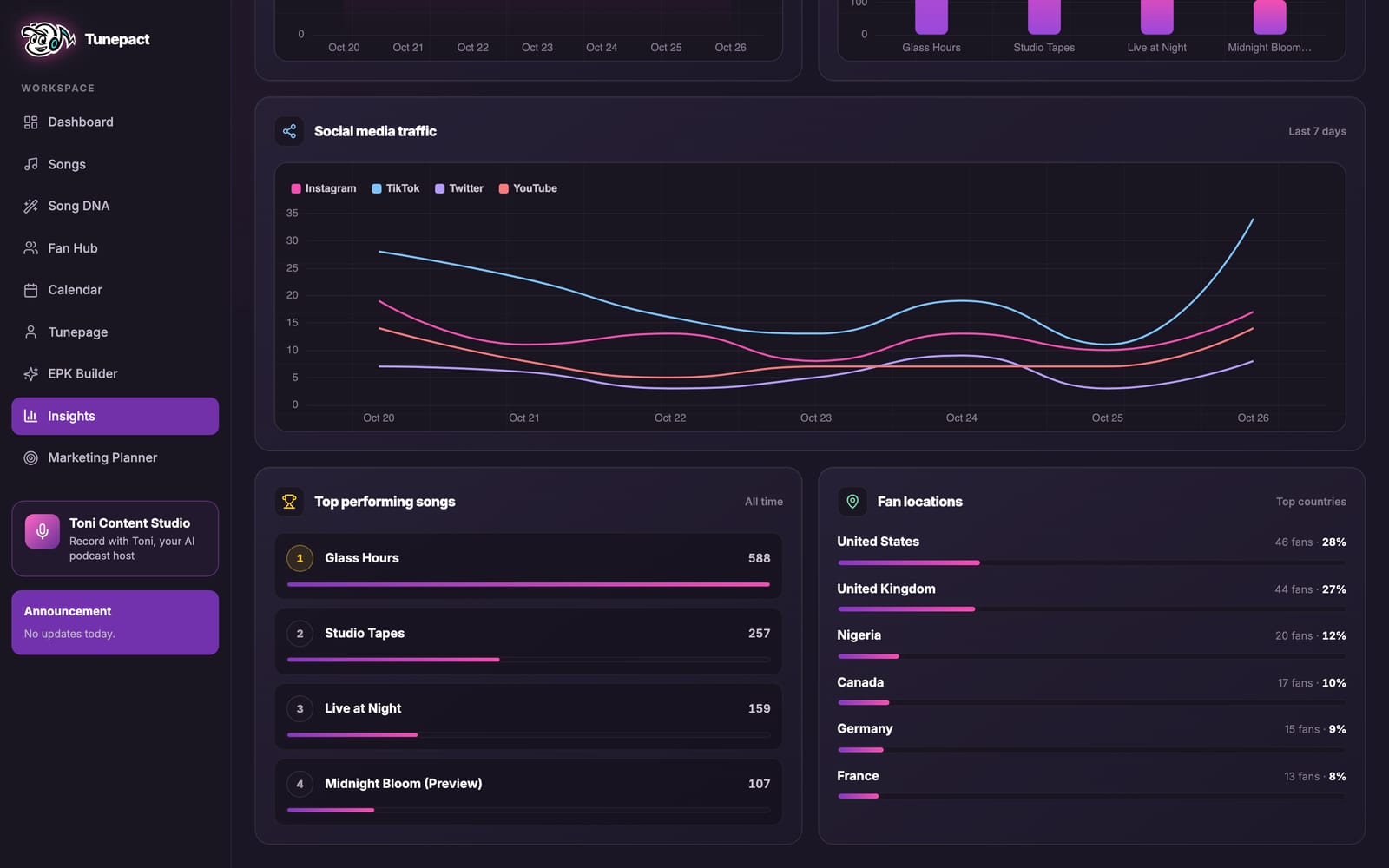
Making smart decisions about physical releases doesn't have to be guesswork. Tunepact Fan Analytics can give you the insights you need to release physical music effectively. This tool helps you track fan growth and see which links and pages your fans engage with.
By looking at your Fan Analytics, you can identify which of your tracks are generating the most buzz. If a particular song's link is getting a ton of clicks and shares, that's a strong signal of demand. This can help you decide which album or single to press first. You can also pinpoint geographical hotspots where your fanbase is most concentrated. If you see a surge of engagement from a particular city, that might be a great place to focus your touring and make sure you have plenty of stock for those shows.
Understanding these fan behavior patterns can also inform your choices. Are fans clicking on premium content or spending more time on pages related to your discography? This might indicate they're willing to invest in higher-tier products like vinyl. This data helps you make decisions about when, where, and what to release, so you're not just guessing. Explore more at
.
Frequently Asked Questions
What's the typical upfront cost for an indie artist to press vinyl?
For an indie artist, the typical upfront cost for pressing 100–200 vinyl records (12-inch LPs) usually ranges from $1,500 to $3,000. This doesn't include mastering specifically for vinyl or artwork design. The cost covers the manufacturing process from lacquer cutting to the finished records and jackets.
How do I decide between vinyl, CD, and cassette for my first physical release?
Decide based on your genre, audience, and budget. Vinyl is a premium option for collectors, CDs are practical and affordable for touring, and cassettes are a niche, low-cost collectible. Think about which format aligns with your music's aesthetic and what your fans have asked for.
What's the best way for an indie artist to sell physical music without a distributor?
The best way is to sell directly to your fans. Use an online storefront like Bandcamp or your own website, and always sell at your live shows. For a broader local reach, you can also try selling on consignment at independent record stores. This maximizes your profit and keeps you in direct contact with your supporters.
How long does it typically take to produce physical music (e.g., vinyl records)?
Production time varies a lot by format. CDs can take 2–4 weeks, but vinyl records typically take much longer, often 3–6 months from final audio approval to delivery. These timelines can extend due to high demand or custom options, so you should plan well in advance.