
Gaining Music Fan Growth: Data Strategies for Independent Artists
You just dropped a track, and for a day, your Spotify streams shot up. It's a great feeling. Then you check back a week later, and the numbers have settled, maybe even lower than before. You're left wondering if that spike was a fluke or real growth. The problem isn't the dip; it's not knowing what that activity actually means. Just chasing stream counts is a recipe for confusion. You need to look for signs of a real connection.
How to tell if you're building a real audience
It’s easy to get fixated on big numbers like thousands of streams or hundreds of new followers. But those can be misleading if they don’t lead to someone sticking around, listening to more than one song, or telling a friend about you. This is why you have to look past the surface of your analytics.
Look for steady growth, not just spikes
A sudden surge in streams from a playlist is good exposure, but how many of those listeners saved your song or followed your profile? That’s the difference between a temporary listen and a new fan. A playlist add gives you a stream spike. But if you don't see a related, lasting increase in your followers or saves in the weeks that follow, it was probably just passive listening. On the other hand, if you're posting consistently on social media and see a steady rise in followers, which then leads to a gradual but sustained increase in your monthly listeners and saves, you’re building a real connection. Spotify’s own research has some useful ideas on how listeners become loyal. You can read the
to learn more.
Calculate your engagement ratios
Instead of only looking at raw numbers, think in ratios. How many likes do you get per follower on a social media post? If you have 10,000 followers but only get 20 likes on a post, that tells a different story than having 1,000 followers and 150 likes. A higher engagement rate usually signals a more invested audience. For example, say you share a link to your new single on Instagram and get 500 clicks from 1,000 story views. That's a 50% click-through rate. But if only 10 of those clicks result in a "save" on Spotify, you know that your initial engagement is high but drops off sharply. Your goal is to see those high rates carry through to deeper actions. Understanding these ratios helps you build a music fanbase that stays, which we've covered in our post on
.
Find your audience in unexpected places
You might think you know where your fans are, but the data often tells a different story. Sometimes the most interesting growth isn't happening where you'd expect.
Uncover your high-growth regions
Your biggest streaming city might be New York or London. But what if a city you’ve never heard of, like Porto Alegre, Brazil, shows a 200% listener growth rate in the last six months, even if the absolute numbers are small? That's a signal. Platforms like Spotify for Artists and YouTube analytics break down your audience by location. Don't just look at the top five cities; scroll down. Look for places with
rapid growth
, even if they're not yet your biggest markets. These could be fertile ground for a targeted ad campaign, or even a place to tour someday. You might find a whole community waiting for you. YouTube data can also show you where people are watching and how they engage from different regions. This article on
from Chartmetric is a good resource.
Look at demographics beyond the basics
Most platforms give you basic demographic data like age and gender. You should combine this with what you see in comments or social media polls. Are your most engaged listeners 18-24 year olds who talk about video games, or 35-44 year olds discussing vintage synths? Knowing this helps you shape your marketing, your visuals, and even the kind of merchandise you might offer. If your analytics show a surprising spike in listenership among 55-64 year olds in a specific country, that might point to a niche community that connects with your sound. You could then craft a small ad campaign for that specific group with language and visuals that speak to them, rather than just broadly targeting "music lovers." This kind of detailed look at your audience helps you build a smarter streaming strategy, as we discussed in our post on
.
Connect the data from different platforms
Your fans don't live on one platform. They might find you on TikTok, listen on Spotify, watch your videos on YouTube, and talk to you on Instagram. The useful insights come when you start connecting those dots.
See if social media buzz creates streams
Did a TikTok using your sound get a lot of attention? Great. Now, check your Spotify for Artists data for the same period. Did that attention lead to more saves, profile visits, or followers? If so, you’ve found a powerful way to get people from one platform to another. If not, it might mean your TikTok content isn't effectively leading people to your music. The key is to look at trends across platforms. A general increase in social media engagement on Instagram and Twitter that happens at the same time as a gradual increase in your Spotify monthly listeners shows growing interest. This is a much stronger sign of growth than a single spike on one platform.
Track how fans move between platforms
How do people go from discovering you to becoming loyal listeners? You can track this path using tools like UTM tags. When you share a link to your music on social media, add UTM parameters to it (for example, `?utm_source=instagram&utm_medium=story&utm_campaign=new_single`). This lets you see in your analytics which post on which platform drove the most valuable traffic—whether that's to your Spotify profile, your Bandcamp, or your merch store. You might find that while your Instagram Reels get lots of views, the link in your bio from a specific Twitter thread about your songwriting process actually drives more people to save your tracks. Understanding these pathways helps you focus your efforts. If you're curious about deeper analytics, you can
to see what tools fit your needs best.
Visualizing Your Fan Growth with TunePact's Analytics
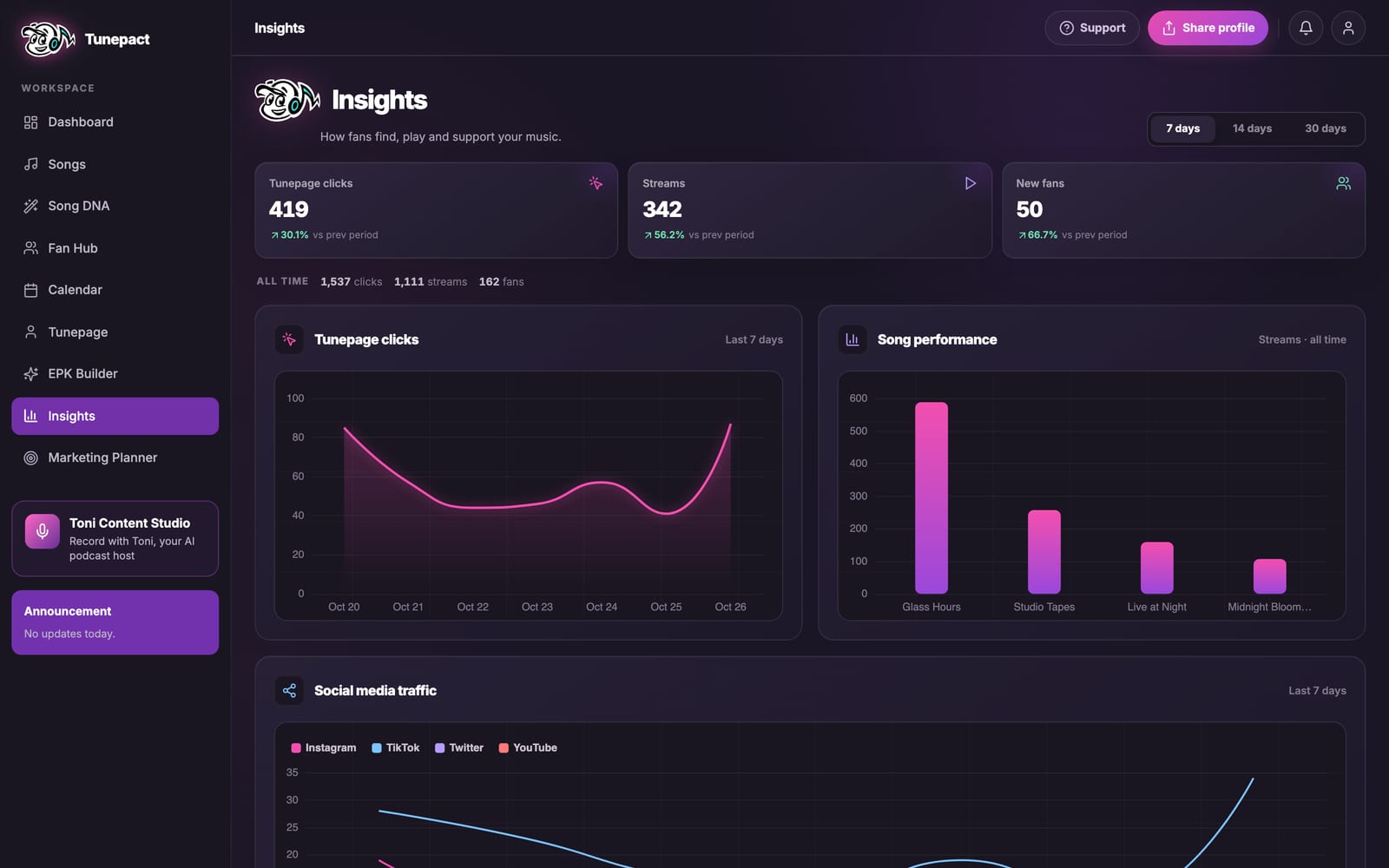
To make sense of all this data, you need a way to see what’s working. You have to track your fan acquisition over time and understand which of your efforts are actually paying off.
TunePact’s Fan Analytics dashboard is designed for this. It lets you **track fan growth and see which links and pages your fans engage with**. This is how you put it to work:
1. **Track your links**: Whenever you share your music, your website, or your social profiles, use a link generated or tracked through Tunepact.
2. **Watch for growth**: On the Fan Analytics dashboard, you’ll see how many new fans you’re acquiring over time. You can watch trends and see if your work is leading to consistent growth.
3. **Find your best channels**: The dashboard shows you which specific links and pages get the most clicks and engagement. For instance, you might share a link to your new single on your Instagram story, in a Facebook post, and in your email newsletter. By looking at the click-through rates, you can quickly see which of those calls to action was most effective. This allows you to focus on what’s actually converting listeners into fans. To get a better handle on your audience, explore the
.
Use your data to make a plan

The point of having data is to use it to make better decisions. Your goal is to adapt and improve.
Test your data-backed ideas
Once you start seeing patterns, you can form a hypothesis. Perhaps your data shows that listeners in Germany are most active between 6 PM and 9 PM CET, suggesting content released then might get more initial traction. Or maybe you've noticed your audience responds better to behind-the-scenes content than polished music videos. You can test these ideas. Try A/B testing two different ad creatives for the same song, one with a direct call to action and one focused on storytelling, and see which performs better. Release your next single at the time suggested by your peak listener data, then try a different time for the following single and compare the engagement. Small experiments like these give you powerful insights without huge risks. The IFPI offers various resources that can help inform your strategies, which you can find on their
.
Retarget and talk to engaged listeners
Data also helps you figure out who your most engaged listeners are so you can focus on them. If you see that people who watched your YouTube music video for more than 75% of its duration are highly likely to then visit your Spotify profile, you can create a specific ad campaign to retarget those viewers. You could invite them to follow you on Spotify or pre-save your next track. You're not just sending ads into the void; you're speaking directly to people who have already shown strong interest. This is how you move from just gaining listeners to consistently gaining active listeners, a topic we cover in our guide on
. Use the data to understand where your potential superfans are, and then give them a clear path to follow.
Frequently Asked Questions About Music Fan Growth Strategies
How can I tell if a spike in streams is real fan growth or just a temporary trend?
Real growth shows up as a sustained increase in related metrics like profile followers, song saves, and repeat listeners in the weeks after the spike. A temporary trend sees these other numbers stay flat or return to baseline quickly. Look for how many listeners convert into followers or savers, as these actions indicate a deeper interest.
What free tools can independent artists use to get useful fan data?
You have access to powerful free tools like Spotify for Artists, Apple Music for Artists, and YouTube Studio Analytics, plus the analytics on Instagram, TikTok, and Facebook. These provide valuable data on listener demographics, geographic reach, engagement rates, and content performance.
Should I focus on my biggest streaming markets or emerging ones for fan growth?
You should engage with both. Your biggest markets are your foundation, so continue to nurture them. But emerging markets with high growth rates represent untapped potential where a focused effort can bring in significant new fans. A balanced approach lets you solidify your existing base while expanding into new territories.
How do I use social media data to understand my music's streaming performance?
Correlate spikes in social media engagement with changes in your streaming data (new listeners, saves, profile visits) from the same period. Use UTM tags on your social links to track which specific posts and platforms drive traffic to your streaming profiles. This helps you understand what social content effectively leads to streaming activity.
