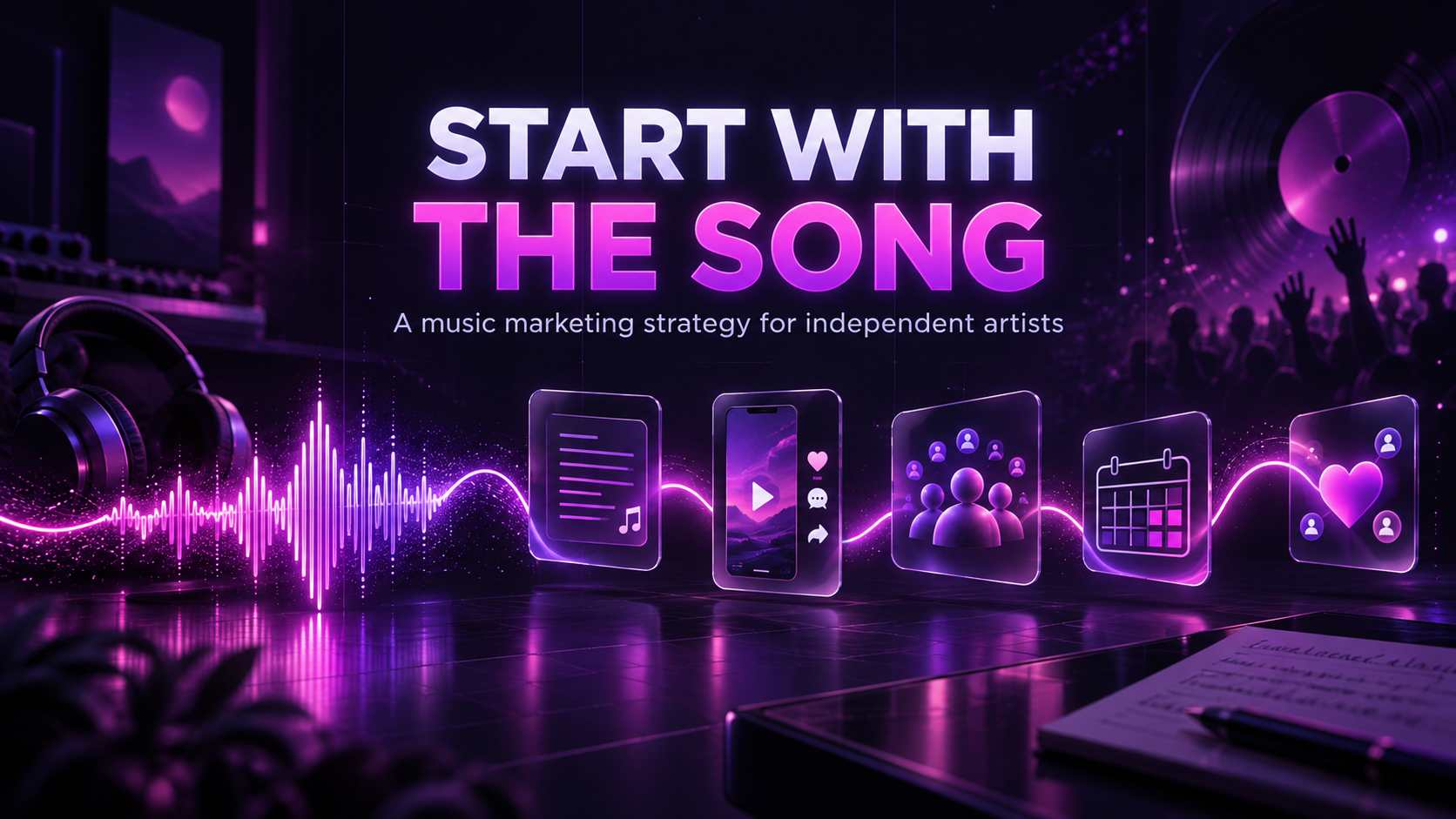
Music Marketing Strategy for Independent Artists: Start With the Song
A useful music marketing strategy does not start with “What should I post today?” It starts with a clearer question: what is this song, who might connect with it, and what should they do next?
When those answers are vague, promotion becomes a cycle of rushed captions, generic countdowns, and links with no clear purpose. When they are clear, one song can supply the language for your description, pitch, social content, release page, EPK, and fan journey.
This guide gives you a practical pre-release framework. It is not a promise of streams, playlists, or virality. It is a way to make each marketing decision more specific and easier to execute.
Begin with a song brief, not a content calendar
Before choosing platforms or spending money, write a short brief for the song you are about to release. Keep it practical. You are not trying to force your music into a box; you are creating language that helps other people understand it.
Answer these five questions:
What does the song sound like?
Name the primary genre, any meaningful blend, the energy, production character, and vocal or instrumental details.What does it feel like?
Identify the mood, tension, atmosphere, and emotional shift. “Sad” may be true, but “late-night, restrained, and slowly cathartic” is more useful.What is it about?
Write the human story or theme in one sentence. Focus on what a listener can recognize, not only the literal lyric.Where does it fit?
Think about listening situations: a night drive, a post-breakup reset, a workout, a quiet morning, a live crowd moment, or a cinematic scene. These contexts can guide your content and research.What makes it distinct?
It could be a production decision, an unexpected lyric, a vocal delivery, a real story, or the contrast between the song’s sound and message.
Here is a fictional example:
“Glass Houses” is an atmospheric alternative-pop song built around pulsing synths, intimate vocals, and a chorus that opens into a bigger emotional release. It is about realizing you have been protecting a relationship that was already breaking. Its strongest mood is late-night, reflective, and quietly defiant.
That brief is already more useful than “new song out soon.” It can become the foundation of your marketing.
Turn one song brief into the assets you actually need
A music marketing strategy works best when every asset tells the same truthful story in a format appropriate for the destination.
Write a description people can understand
Your song description is not just a formality for a release page. It gives fans, curators, writers, venues, and collaborators a fast way to understand the track.
Use this simple structure:
[Song title] is a [genre or blend] track that pairs [sound/production detail] with [mood]. It explores [theme or story], making it a fit for listeners who connect with [context or emotional experience].
For the fictional example:
“Glass Houses” is an atmospheric alternative-pop track that pairs pulsing synths with intimate vocals and a slow-building chorus. It explores the moment you stop trying to save a relationship alone, landing somewhere between late-night reflection and quiet resolve.
You can then adapt that core version for a playlist pitch, EPK, social caption, release page, or Tune.page without inventing a different story each time. If you need help shaping the wording, use the Song Description Generator as a starting point, then edit the result until it sounds like you.
Build a pitch around context, not hype
A pitch should make it easier for someone to understand why your release may fit their audience. Avoid unsupported claims such as “this will go viral” or “guaranteed playlist hit.”
Instead, explain:
the song’s genre and mood;
the story behind it;
relevant listening or cultural context;
your planned activity around release;
the single strongest reason someone should listen.
For example:
“Glass Houses” is an atmospheric alternative-pop song about choosing clarity after a relationship has become one-sided. The track combines intimate verses with a larger, synth-led chorus, making it a natural fit for reflective late-night pop and breakup-recovery listening. I’ll support the release with a behind-the-song video, lyric-led short-form clips, and direct fan outreach.”
Specific is more credible than inflated. It also gives you a better base for a Spotify for Artists pitch. Spotify says eligible unreleased songs can be pitched to editors, and recommends delivery at least seven days before release; pitching does not guarantee placement. Review Spotify’s current pitching guidance before submitting.
Choose one campaign job
A release can have several goals, but every individual piece of content should have one primary job. Otherwise, people see the post and do not know what to do next.
Choose the most important job for this song:
Get current followers to listen on release day.
Encourage pre-saves or follows before release.
Introduce the artist to new listeners through short-form content.
Give media, curators, or booking contacts a clean way to understand the release.
Turn interested listeners into direct fans through a signup or message.
Then match the destination to the goal. A listener should not have to search through five disconnected links to find the song, learn who you are, or take the next step.
For example:
Campaign momentPrimary jobBest next stepTeaser videoCreate curiosityVisit your release linkBehind-the-song postBuild connectionSave the song or followOutreach to a writer or venueEstablish credibilityOpen your EPKRelease-day postMake listening easyPlay the song from your Tune.pageFan-only messageDeepen the relationshipReply, join, or share
Create content from the song itself
You do not need a separate idea for every platform. You need a few real angles that can travel across formats.
Use your song brief to create three to five content angles:
The story angle: What happened, changed, or became clear while writing the song?
The lyric angle: Which line captures a feeling people may recognize immediately?
The production angle: What sound, instrument, sample, arrangement shift, or vocal choice defines the track?
The listener angle: Who may see themselves in the song, and when might they play it?
The contrast angle: Is the track danceable but heartbroken, minimal but intense, bright-sounding but heavy in meaning?
For “Glass Houses,” a short video might open with: “This song is for the moment you realize you are the only person still trying to fix it.” A second post could show how the chorus changes when the synth layer enters. A third could ask listeners: “What is the line between patience and abandoning yourself?”
Those are different posts, but they belong to the same release world.
Make the pre-release period easier to manage
Your exact schedule depends on your release date, distributor timing, and available time. The key is to prepare the core assets before release week.
A simple sequence looks like this:
Three to four weeks before release
Finalize the song brief, release goal, artwork, key links, description, and the first content angles. Confirm what a new listener should do after discovering the track.
Two weeks before release
Prepare your EPK or artist page, write your outreach notes, make short-form drafts, and choose the strongest version of your pitch. If Spotify is part of your plan, check that your distributor has delivered the release and that it appears in Spotify for Artists’ Upcoming section.
One week before release
Schedule only what you can realistically maintain. Test every link on mobile. Give collaborators a clear asset folder and one or two messages they can share authentically.
Release day and after
Lead with the strongest hook, make listening easy, and spend time responding to real replies. Then continue using the angles that generate meaningful conversation, not just the ones you expected to work.
For a detailed release timeline, use this four-week single-promotion plan.
Use Tunepact Song DNA as the first step
Tunepact Song DNA is built for this pre-release moment. Upload your track to explore its identity, mood, themes, production perspective, potential audience, comparable references, opportunities, and content directions.
The goal is not to replace your creative judgment. It is to give you clearer language and practical next actions before your music is out in the world.
Start with the song, then use what you learn to:
tighten your description and pitch;
choose content angles that match the track;
create a focused promotion plan;
build an EPK or Tune.page that tells the same story;
give interested listeners a simple path to stay connected.
A better marketing strategy does not mean pretending every song is for everyone. It means helping the right people recognize why this one may be for them.
Analyze your song with Tunepact Song DNA and start your next release with a clearer path forward.
Make Your Music Move.