How Independent Artists Can Boost Music Discovery with Spotify AI
Crafting AI-Friendly Descriptions for Your Music
From Hashtags to Human Language
The way listeners find new music is changing. Curated playlists are no longer the only factor; increasingly, AI systems are interpreting requests and matching them to music. This means the old approach of stuffing keywords or just using generic tags like "#indie" or "#newmusic" isn't going to cut it.
AI models like the ones powering Spotify's recommendations or even tools like ChatGPT, are getting smarter. They don't just look for exact keyword matches. They understand context, mood, and nuances in language. If you want your music to show up when someone asks for "chill indie tracks with a dreamy vibe," your track descriptions and artist bios need to reflect that in a natural, conversational way.
Think about describing your music as if you were talking to a friend, not a search engine from 2005. Instead of just "Alternative Pop," try "Dreamy alternative pop with introspective lyrics and layered synth textures, perfect for late-night drives." Or, if your track is "Lo-fi," consider "Warm, lo-fi bedroom pop with jazzy undertones and a nostalgic, melancholic feel." This kind of rich, human-readable description gives the AI far more to work with, helping it understand the true essence of your sound. Remember, for the music industry, metadata is the industry's weak spot in the age of AI. The cost of half-measures is far higher than taking the time to get this right.
It's more than just your song description on Spotify. It's about how you describe your music to your distributor, in your press kit, and on your website. Every piece of descriptive text is a chance for AI to learn more about your sound. And if you're looking to explore further into getting your data right, understanding the critical role of accurate music metadata is a great place to start, or consider implementing proactive music metadata strategies from the get-go.
Understanding How AI Recommends Your Tracks
What the AI Listens For
When an AI recommends a track, it doesn't simply guess. Instead, it analyzes a complex web of data points. Think about what goes into a song: the genre, yes, but also the mood (is it energetic, melancholic, uplifting?), the instrumentation (acoustic guitar, heavy synths, driving percussion?), the vocal style (whispered, powerful, soulful?), and even lyrical themes (love, protest, introspection?). These are all elements the AI considers.
Let's say a listener asks ChatGPT for "upbeat electronic music for working out with a 90s feel." The AI will process that request, breaking it down into genre (electronic), mood (upbeat, workout), and specific sonic characteristics (90s feel). It then sifts through its vast database, looking for tracks whose metadata and audio analysis align with those parameters. If your track "Neon Pulse" is tagged simply as "Electronic," it might get overlooked. But if its description includes "Upbeat synth-pop with a driving beat and nostalgic 90s rave influences, ideal for high-energy workouts," the AI has a much clearer path to recommending it.
The key here is consistency. Your sound needs to be clearly and consistently categorized across all platforms. If Spotify thinks you're "Indie Rock" but your distributor has you down as "Acoustic Folk," the AI gets confused. This dilutes its confidence in recommending your music. It's why mastering Spotify's new AI chatbot for listener discovery is becoming essential for independent artists.
You can also enable AI discovery on Spotify through prompted playlists, using the same logic: the more clearly you define your sound with rich, descriptive language, the better chance AI has of placing your music where it belongs.
Using Tunepact Song DNA to Optimize Your AI Profile
Translating Analysis into AI-Ready Descriptions
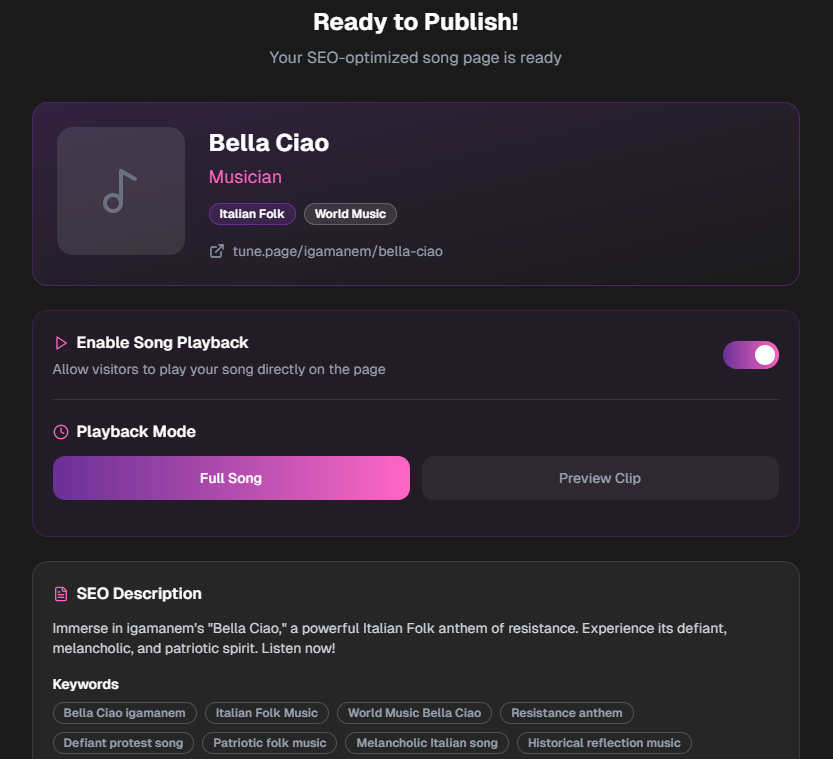
One of the biggest challenges for artists is objectively describing their own music. You know how it *feels*, but how do you translate that into objective, AI-friendly language? This is where tools designed for artists come in. Tunepact Song DNA analyzes your song before release to understand its sound, mood and the listeners it fits.
Here’s a practical way to use its insights:
- Analyze Your Track: Upload your song to Tunepact Song DNA. It will provide a detailed breakdown of your track's characteristics, such as its energy levels, mood (e.g., melancholic, uplifting), specific genre fit, and prominent instrumentation.
- Identify Key Descriptors: Look at the objective output. You might see terms like "atmospheric," "dreamy," "acoustic-driven," "lo-fi production," "driving rhythm," or "female lead vocals." These are the building blocks for your AI-friendly descriptions.
- Combine Insights with Your Vision: Take the objective analysis and weave in your unique artistic perspective. Don't just list the terms; make them flow naturally.
- Craft Your Description Template:
Start with: "[Genre] with a [mood] feel and [key sonic characteristic 1], featuring [key instrumentation/vocal style]. Perfect for [listener activity/mood]."
For example, if Song DNA identifies your track as "Indie Pop," "melancholic," "atmospheric," with "synth pads" and "male vocals," you might write:
"Melancholic indie pop with atmospheric synth pads and yearning male vocals, crafting a soundscape perfect for reflective evening listens or thoughtful contemplation."
This template translates objective data into compelling, AI-digestible language for Spotify, your distributor, and your website. It’s about giving the AI specific, rich details it can confidently match to listener queries.
Building a Consistent Digital Footprint for AI Visibility

Why Cross-Platform Harmony Matters
AI systems don't just live on one platform. They are constantly cross-referencing information about you and your music from various sources. This includes Spotify, YouTube, Apple Music, social media platforms, your distributor's metadata, and even your official website. They're trying to build a comprehensive profile of you as an artist and your musical output.
If there are inconsistencies across these platforms, it can confuse the AI. Imagine your artist name is "The Echoes" on Spotify, but "Echoes Band" on YouTube, and your distributor lists your genre as "Rock" while your social media bio says "Alternative Pop." To an AI, these discrepancies create uncertainty. It lowers the system's confidence in accurately categorizing and recommending your music, effectively making you less visible.
Here's a checklist to ensure your digital footprint is AI-friendly:
- Artist Name: Ensure it's identical on every platform and release.
- Track & Album Titles: Exact spelling and capitalization everywhere.
- Genre Tags: Use consistent, specific genres across all distributor submissions and platform profiles.
- Release Dates: Accurate and identical across all listings.
- Social Media Handles: Link consistently and ensure the handles themselves are consistent where possible.
- Website Links: Ensure all links to your official site are correct and up-to-date.
- Artist Bio: Maintain a consistent narrative and descriptive language about your sound.
Even small differences can create friction for AI. It's like giving a detective conflicting clues; they'll struggle to piece together the full picture. The IFPI Global Music Report 2026 highlights how vital accurate data is for the entire music ecosystem, including combating issues like streaming fraud. For independent artists, this level of consistency is not merely good practice; it's a direct route to better AI-driven discovery. If you haven't already, reviewing and implementing proactive music metadata strategies will pay dividends.
Proactive AI Music Promotion Strategies
Engaging with How Music is Now Discovered
You don't have to be a passive observer in the age of AI. You can actively engage with these new tools to understand and even influence how your music is discovered. It's about being curious and experimental.
One effective strategy is to become familiar with AI tools yourself. Try using ChatGPT, for example, and ask it questions like, "Recommend artists similar to [Your Artist Name]" or "Create a playlist for [mood] featuring indie artists." See what results it gives you. This can reveal how well your current metadata is performing and where there might be gaps. It’s a direct way to peek into the AI's "mind."
You can also encourage your fans to interact with AI in ways that benefit you. On social media, you might post, "Hey, try asking ChatGPT for 'dreamy indie pop like [Your Artist Name]' and let me know what it recommends!" This not only helps train the AI with more data points related to your music but also engages your audience in a novel way. It turns discovery into a fun, interactive game.
Finally, keep an eye on AI-generated playlists and recommendations within your genre. Many platforms now feature playlists created by algorithms. Paying attention to what's showing up there can give you insights into emerging trends, popular descriptive language, and even potential collaborators or artists whose sound aligns with yours. It’s about staying agile and adapting to how listeners are finding their next favorite song.
Frequently Asked Questions About AI Music Promotion
How does ChatGPT actually 'discover' my music on Spotify?
ChatGPT doesn't directly "listen" to your music, but it integrates with Spotify's API. This means when you ask it for music, it queries Spotify's vast database, which includes all the metadata you provide about your tracks (genre, mood, descriptions) and Spotify's own audio analysis of your songs. ChatGPT then uses its language understanding to match your request with the most relevant music data from Spotify.
What's the most important piece of metadata for AI music recommendations?
There isn't one single "most important" piece; it's the combination of rich, consistent, and accurate metadata across all fields. However, if forced to choose, a well-crafted, descriptive free-text track description that goes beyond generic genre tags, combined with consistent genre and mood classifications, gives AI the most comprehensive understanding of your music's essence.
Can AI tools help me understand my audience better?
Indirectly, yes. By observing which AI-generated playlists your music appears on, or by experimenting with queries yourself, you can gain insights into how your music is being perceived and categorized by algorithms. This can help you refine your target audience descriptions or even identify new niches your music fits into.
Will AI replace traditional music promotion methods for independent artists?
No, AI won't replace traditional promotion. It's a powerful new tool that enhances and complements existing methods. AI can help with discoverability, but human connection, engaging storytelling, direct fan interaction, and strategic outreach (like pitching to blogs or playlists) remain essential for building a sustainable career and a loyal fanbase. Think of AI as an incredibly smart assistant, not a replacement for your hustle.