
Your Music's Metadata Could Be Losing You Royalties
You’re about to release a new single, or maybe you just got your first royalty statement and you’re squinting at the numbers, wondering if it all adds up. If the information about your music is even slightly off in a database somewhere, money you’ve earned can easily end up in the wrong place. To make sure every penny finds its way to you, you have to audit your own music metadata and fix the registration errors that are surprisingly common.
How to find the errors that are costing you money
It’s easy to assume that major artists have this all figured out, but even some of the biggest songs in history have metadata problems. We're talking about a recording getting linked to the wrong song, or songwriter splits being mislabeled. If it happens to them, it can definitely happen to you, and for an independent artist, every lost dollar stings.
The issue is that small errors in artist names, track titles, or contributor splits can misdirect your royalties. Imagine your track gets a million streams, but because a co-writer's name is misspelled in one database, their share gets held up. It’s like sending a letter with the wrong house number. It’s not going to the right mailbox.
You need to become your own detective. Start by checking your song registrations across the three places that matter most: your Performance Rights Organization (PRO), the Mechanical Licensing Collective (MLC), and your distributor. They all need to tell the same story.
Let's walk through it with one of your songs. We'll call it "Midnight Serenade."
- Log into your distributor (DistroKid, TuneCore, etc.). Find "Midnight Serenade" and write down every songwriter and publisher listed, along with their percentage splits.
- Now, log into your PRO account (ASCAP, BMI, SESAC, etc.). Search for "Midnight Serenade." Compare the listed songwriters, publishers, and splits with what you found at your distributor.
- Do the same thing in your MLC portal. The MLC is focused on mechanicals, but getting your composition data right here is necessary for collecting all your mechanical royalties. They also list publisher and songwriter information.
Are all three identical? If your distributor lists "Jamie Lee" and your PRO lists "J. Lee," that's a discrepancy. If a co-writer is listed on your PRO but not your distributor, that's a red flag. These are the kinds of common, fixable problems that can prevent you from claiming unclaimed MLC royalties or ensuring your music publishing for independent artists is set up correctly.
The two kinds of data you need to know
Your music has two distinct sets of data that often get confused. Understanding the difference is fundamental to getting paid properly.
ISRC, ISWC, and other codes
You’ll hear about ISRCs and ISWCs a lot, and for good reason. They are the two most important codes you need to understand.
- ISRC (International Standard Recording Code): This is a unique code for a specific *sound recording*. Every version of your song (the album version, radio edit, acoustic, live) needs its own ISRC. Your distributor usually assigns these. It’s how systems track plays for your specific recording.
- ISWC (International Standard Musical Work Code): This is a unique code for the *musical composition* itself (the underlying song). It identifies the song no matter who performs it or how many recordings exist. Your PRO usually assigns this when you register the song.
An ISRC tells the system "this specific recording was played," while an ISWC tells it "this underlying song was used." You need both to make sure the recording owner (you) and the songwriters (also you) get paid for their respective rights.
Sound recording data vs. composition data
This is where many artists get tripped up. Your music generates two copyrights: one for the sound recording (the master) and one for the musical composition (the song itself). Each has its own metadata.
- Sound Recording Data: This includes the ISRC, artist name, track title, album, and release date. Your distributor manages this when you upload your music.
- Musical Composition Data: This includes the ISWC, song title, songwriter names, publisher names, and their percentage splits. Your PRO and the MLC manage this data.
A common mistake is mixing these up. For example, if you accidentally put information about the sound recording into your PRO registration for the composition, royalties can get misdirected. Always remember: the recording is what people *hear*, the composition is what was *written*. Spotify's official music metadata guidelines are a good reference for the level of detail you need. Being organized with your data from the start is the core of proactive music metadata best practices.
Tunepact tip: Get a personalized, step-by-step marketing plan for your next release. Plan your release →
Your plan for auditing and fixing your data
Now that you know what to look for, it’s time to get organized. This isn't a one-off chore; it's a regular part of running your music business. Schedule an hour every few months to do this, especially after a new release.
Get all your data in one place
Before you can compare anything, you need all your information in front of you. Create a folder for this and gather these documents:
- Distributor Release Details: Export or screenshot the detailed information for each track from your distributor's portal. This should include ISRCs, exact track titles, artist names, and listed songwriters.
- PRO Work Registrations: From your online PRO account, find the registration details for each of your compositions. Note the ISWC, song title, all writers, publishers, and their exact percentage splits.
- MLC Portal Details: Check your registered works and ownership shares there.
- Co-writing Agreements: Any documentation, even an email, that confirms splits with your collaborators.
Find and fix the mismatches
The easiest way to spot problems is with a simple spreadsheet. Create columns for:
- Song Title
- ISRC (from Distributor)
- ISWC (from PRO)
- Songwriters (Distributor)
- Songwriters (PRO)
- Songwriters (MLC)
- Publisher (Distributor)
- Publisher (PRO)
- Publisher (MLC)
- Splits (Distributor)
- Splits (PRO)
- Splits (MLC)
- Notes/Discrepancies
Go through each song, row by row, and fill in the data. When something doesn't match across the different sources, highlight it. This visual check makes it obvious where the problems are.
Here’s how you fix a common issue, like a misspelled artist name in your PRO registration.
- Identify the Mismatch: Your distributor lists you as "Aura Bloom," but your PRO has you as "Aura Blome."
- Gather Evidence: Your name is "Aura Bloom" everywhere else—your website, social media, and distributor. This consistency is your proof.
- Contact the Source of the Error: In this case, your PRO. Log into their member portal and look for a section like "Update Profile," "Contact Us," or a "Work Registration Dispute" form.
- Submit the Correction: State the issue clearly. "My artist name is incorrectly spelled as 'Aura Blome' for the work 'Starlight Symphony' (ISWC: T-123.456.789-0). My correct artist name is 'Aura Bloom'."
- Follow Up: Keep a record of your communication. If you don't hear back within their stated timeline, follow up politely.
This same process works for incorrect co-writer splits or misattributed songs. The key is to be precise, provide clear evidence, and follow up. Staying on top of this prevents small issues from becoming big ones, which is the whole point of proactive music metadata management.
How to get your metadata right from the start

The best way to deal with metadata errors is to prevent them. A little extra care before you release a song can save you hours of headaches later.
Create your pre-release checklist
Before you submit any new music, run through this checklist:
- Confirm ISRC: Make a note of the ISRC your distributor assigns as soon as you have it.
- Verify All Contributors: List every songwriter and publisher with their legal names and agreed-upon splits. Double-check the spelling.
- Consistent Naming: Your artist name and track title must be identical everywhere. "Song Title (feat. Artist X)" is different from "Song Title Feat. Artist X" to a database. Pick one format and stick to it.
- Version Control: If you have a "Radio Edit" or "Instrumental," make sure they are clearly and consistently labeled. Each version needs its own ISRC.
- Publisher Information: Ensure your publisher name (even if it's your own company) and PRO affiliation are correct across your distributor and PRO registrations.
- Genre and Language: While not directly tied to royalties, accurate genre and language tags help people find your music.
Metadata isn't a one-time job
Don't think of this as a "set it and forget it" task. Your career evolves, you collaborate with new people, and sometimes collection societies update their systems. A quarterly or bi-annual review is a good habit. It helps you catch new discrepancies, make sure new collaborations are properly registered, and keep your entire catalog clean.
The music industry's reliance on data is only growing. As a recent Music Business Worldwide article pointed out, metadata is the industry's weak spot in the age of AI. The work you do today will safeguard your earnings for years to come.
A tool to help you stay organized
Managing all these details can feel like a lot, especially when you're also trying to create and promote your music. This is where a smart tool can help you keep things straight.
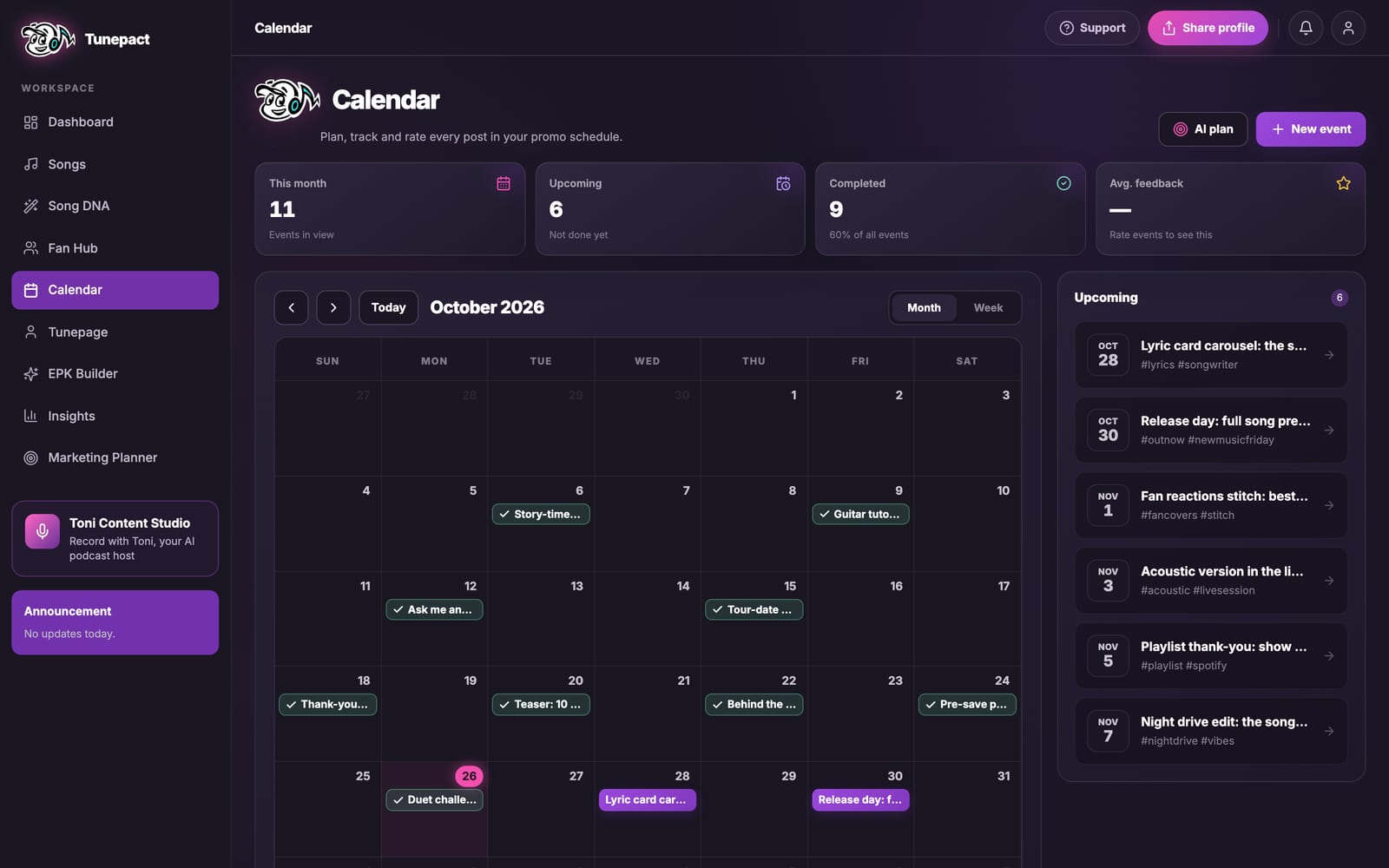
The Tunepact AI Music Marketing Planner helps you get a personalized, step-by-step marketing plan for your next release. While its main job is marketing, it also works as a great pre-flight check for your metadata. Before you think about your launch, the planner guides you through structured prompts for your ISRC, ISWC, publisher details, and co-writer splits. This forces you to get all these pieces of data ready and consistent before you submit your track anywhere.
Using a tool like the Tunepact AI Music Marketing Planner helps you build good habits. By making metadata verification part of your marketing plan, you create a system where accurate data supports better discoverability and ensures you collect every royalty you've earned.
Frequently Asked Questions
What's the difference between ISRC and ISWC codes, and do I need both?
An ISRC (International Standard Recording Code) identifies a specific sound recording, while an ISWC (International Standard Musical Work Code) identifies the underlying musical composition. Yes, you absolutely need both: the ISRC tracks plays of your recording for master royalties, and the ISWC tracks uses of your song for publishing royalties.
How often should I audit my music metadata?
You should perform a full metadata audit at least once a year, and ideally, after every new release or significant collaboration. A quick check of key fields (artist name, track title, ISRC, ISWC) should be part of your routine before every release submission.
What should I do if I find an error in my metadata after release?
First, identify where the error exists (distributor, PRO, MLC). Then, gather any evidence you have of the correct information. Contact the relevant organization's support or member services with clear details of the error and the correction needed, and follow up until it's resolved.
Can bad metadata affect my song's discoverability on streaming platforms?
Yes, absolutely. Inconsistent artist names, misspelled titles, or incorrect genre tags can make it harder for listeners to find your music through search or algorithmic recommendations. For your song to be properly categorized and discovered, its metadata needs to be accurate and consistent.
