
How to Collect Every Mechanical Royalty You're Owed
You just got your latest distributor statement, and you're happy to see your streams are up. But when you look closer, the numbers don't feel like the whole story. You know your song is getting played, but the payment seems low. It’s a familiar problem, and it usually means you’re leaving money on the table. Specifically, you’re missing out on mechanical royalties, which are paid every time your song is reproduced. This isn't about getting rich quick; it's about getting paid for your work.
What a mechanical royalty actually is
Every song you create has two copyrights: one for the sound recording (the master) and another for the composition (the music and lyrics). Your distributor pays you for the sound recording. Mechanical royalties are different. They're payments for the reproduction of your *composition*. Every time your song is streamed, downloaded, or pressed onto a CD, a copy of your composition is being made. That's a mechanical reproduction, and you're owed a royalty for it.
So a single stream on Spotify generates two royalties: one for the master (which your distributor pays you) and one for the composition. The same thing happens with downloads from Bandcamp or if you sell a CD at a show. Many artists miss out on this money because they think their distributor handles it all, but that's rarely the case. If you're weighing your options, our
breaks down what different services handle for you.
How to register your songs and publishing
You wrote the song, so you own the composition. That makes you both the songwriter and the publisher. And since mechanical royalties are paid to publishers, the only way to get that money is to register your songs correctly.
Why you're your own publisher
As an independent artist, you're usually your own publishing administrator. That job involves registering your work and making sure the money finds its way to you. Start by registering your songs with a Performing Rights Organization (PRO) like ASCAP or BMI. While that mostly covers performance royalties, it’s an essential first step. For mechanicals, the next step is registering your compositions with The Mechanical Licensing Collective (The MLC). If you don't register with both, your money just sits in an account, unclaimed. To get into the details, our guide on
can walk you through it.
Get your co-writing splits in writing
This is where collaborations often hit a snag. If you co-write a song, you need a clear, written agreement on the songwriting splits. A handshake won't do. A simple email confirming the percentages for each writer is enough to prevent future headaches. For a 50/50 split of the entire composition, it could be as simple as, "We agree to the following splits for 'Song Title': Writer A gets 50% and Writer B gets 50%." When you register the song with your PRO and The MLC, you'll enter these exact percentages. If you don't have this sorted out and the song starts making money, payments can be frozen until the dispute is resolved. A clear agreement from the start means the money flows correctly to everyone involved.
How The MLC gets you paid from streams
For digital mechanical royalties in the U.S., The MLC has simplified things enormously. Before it existed, collecting this money from streaming services was a mess. Now, The MLC is a central hub. Services like Spotify and Apple Music report their usage to The MLC, which then matches those streams to the songs in its database and pays the publishers. That's you. It makes getting paid much more straightforward.
To get paid by The MLC, you have to do three things:
- Register on The MLC's website. Sign up as a self-administered songwriter. This tells them you’re your own publisher.
- Add your songs to their database. This means entering song titles, ISWC codes from your PRO, and the correct songwriter splits you agreed on.
- Keep your data consistent. This is where most people go wrong. The MLC matches streams to songs using data. If the song title, writer names, or splits you enter at The MLC don't match what's at your PRO and your distributor, you won't get paid. Check that your data is identical everywhere.
Accurate data is what ensures every stream turns into a payment. Spotify for Artists has a helpful article explaining
.
Build royalty collection into your release plan
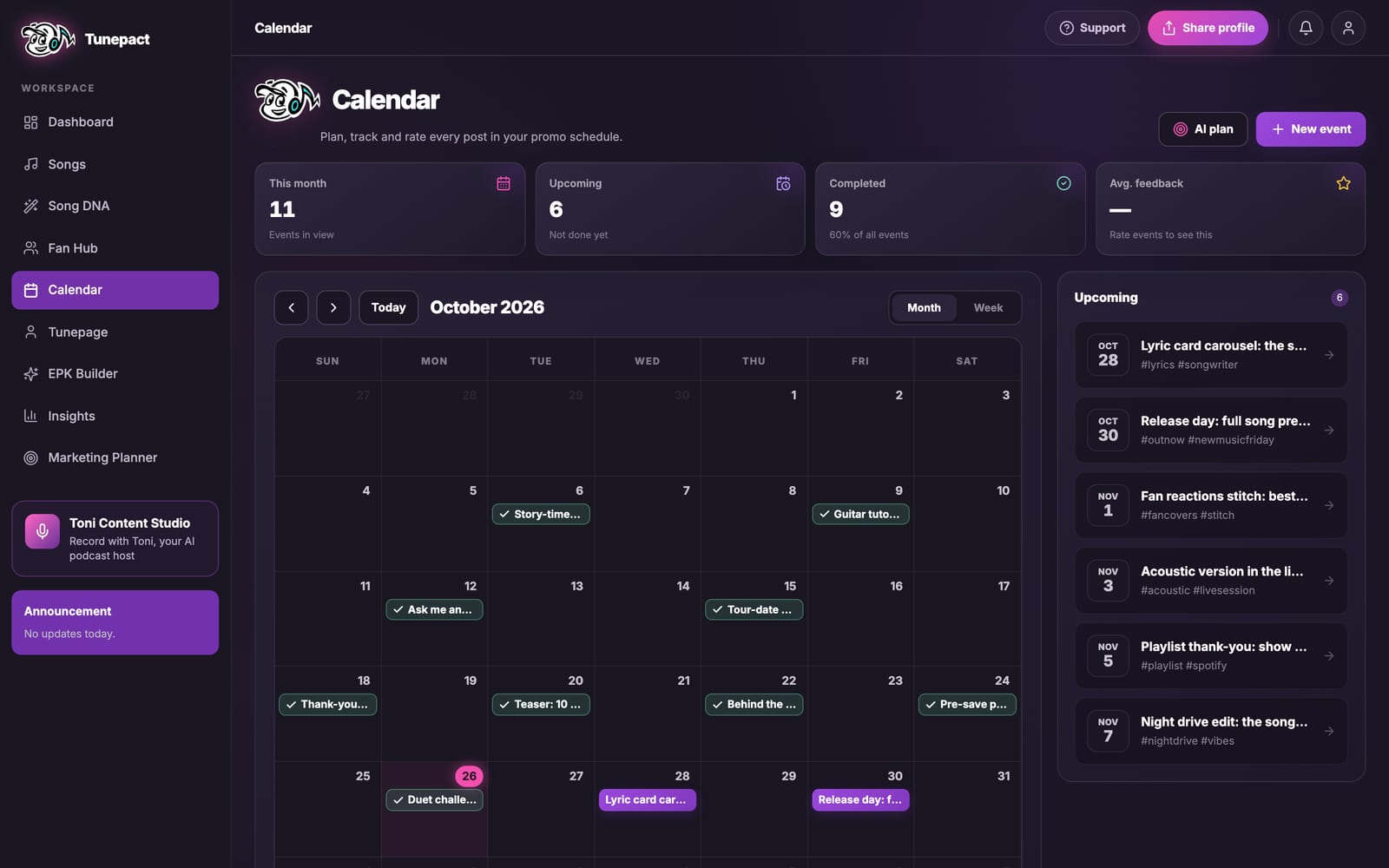
This admin work shouldn't be an afterthought. It has to be part of your release plan. Imagine you're releasing a single next month. Your artwork is done, your social posts are scheduled, and the track is uploaded to your distributor. But if you haven't registered the composition with your PRO and The MLC, you're launching a product without a way to get paid for it. Your song could be streaming for months before you get the paperwork sorted and the money starts flowing to you.
Use a plan to get the admin work done
A structured plan makes this stuff manageable. The AI Music Marketing Planner gives you a personalized, step-by-step marketing plan for your release, and it can include tasks that remind you to handle your royalty registrations.
For example, your plan might include a task for three weeks before release: "Register 'My New Single' with The MLC and confirm songwriter splits. Add ISWC code from PRO." This turns a boring admin chore into a simple checklist item in your release plan, so you don't forget it. Planning ahead means you're set up to collect everything you're owed from day one, which is a key part of
. You can try the
and see how it fits into your process.
How to find and claim your unpaid royalties

What if you've been releasing music for years and are just learning this now? Don't panic. You probably have unclaimed mechanical royalties waiting for you. The MLC keeps a public database of these "unmatched" works—songs that earned royalties but couldn't be paid out because of bad or missing registration data. It's time to go hunting for your money.
Here's what to do:
- Search The MLC's public database. Go to their portal and search for your song titles, your name, and your co-writers' names.
- Gather your proof of ownership. If you find a match, you'll need to prove the song is yours. This means having your PRO registration info, split sheets, and other details ready.
- Submit your claim. Follow the instructions on The MLC's site carefully.
- Be patient. Verification can take time, but it's worth the wait.
There are deadlines for claiming these past royalties, so don't put it off. Our guide on
walks through the process in more detail.
Frequently Asked Questions About Mechanical Royalties
Do I need a publisher to collect mechanical royalties?
No. As an independent artist, you can act as your own publisher. This is called self-administering your publishing. It just means you're the one responsible for registering your songs with The MLC and keeping your data accurate. While some artists hire a publishing administrator to do this work, it isn't required.
How often are mechanical royalties paid out?
The MLC generally pays out mechanical royalties every three months. But it takes time for money from streams to be collected and processed, so the timing can shift. Check The MLC's official payment schedule on their website for the most current info.
What's the difference between mechanical and performance royalties?
Mechanical royalties come from the *reproduction* of your song's composition—think streams, downloads, or CDs. Performance royalties come from the *public performance* of your composition—on the radio, on TV, or in a bar. A single stream actually generates both. Your PRO (like ASCAP or BMI) collects your performance royalties, while The MLC collects your digital mechanical royalties from streaming in the U.S.
Can I collect mechanical royalties for cover songs?
No, you can't collect the *composition* royalties for a cover song. Those mechanical royalties belong to the original songwriter and their publisher. When you release a cover, you are only creating a new *master recording*. You'll earn royalties for that recording from your distributor, but the mechanical royalties for the underlying song must be paid to the original writers.