
Flat Fees Versus Revenue Share: Music Distribution Pricing Decoded
You’ve just finished mixing your latest track, and you’re buzzing, ready to get it out there. Then you open up two distribution platforms side-by-side. One advertises "keep 100% of your royalties for just $20 a year." The other says, "no upfront fees, we just take 15%." Your brain immediately tries to do the math to figure out which one saves you more money. It’s a common moment of paralysis. But the mistake is thinking this is just a math problem. The right choice isn't about what's cheapest on paper; it's about picking the model that fits your release plan and your goals right now.
How Flat Fees and Revenue Share Actually Work
You have two main ways distributors charge you to get your music onto Spotify, Apple Music, and everywhere else.
With a **flat-fee model**, you pay an upfront cost. This might be per release, per year for unlimited releases, or a one-time fee. Once that fee is paid, you typically keep 100% of the royalties that come back to you from streaming platforms and digital stores. Think of it like buying a bus ticket: you pay once, and you get to your destination. This model is common with music aggregators, which mostly focus on getting your music live and collecting royalties without many extra services.
The **revenue-share model** is different. You usually don't pay anything upfront. Instead, the distributor takes a percentage of the royalties your music generates. So, if your track earns $100 and the distributor takes 15%, you get $85. This percentage can range from 5% to 30% or more, depending on the services included. This is more common with full-service distributors, who often provide more hands-on support. You can find more detailed breakdowns like this one from Symphonic on
.
The key difference in your payout is simple: with flat fees, your gross royalties (after platform fees) are untouched by your distributor. With revenue share, the distributor takes their cut before that money hits your account.
When a Flat Fee Model Makes Sense for Your Music
A flat fee gives you predictable costs. Once you earn more than that fee, you keep everything else.
Who Should Consider a Flat Fee
This model often works best for artists who are just starting out, have a consistent release schedule but modest stream counts, or are releasing a lot of music. If you're putting out a single every month and each one brings in, say, $30–$50 in royalties annually, a yearly flat fee of $20–$35 for unlimited releases is very cost-effective. You know exactly what you're paying each year, and every dollar above that is yours.
Calculate Your Break-Even Point
Let's get specific. Imagine a flat-fee distributor charges you $20 per year for unlimited releases. Now, compare that to a revenue-share distributor taking 15% of your royalties. To figure out when the flat fee is better, you calculate your break-even point. Divide the flat fee by the revenue share percentage (as a decimal). So, $20 / 0.15 = $133.33. This means if your music earns *more* than $133.33 in a year, you'll keep more money with the $20 flat fee. If you earn less, the revenue share model would have been cheaper.
Think about an artist like Sarah. She releases 10 tracks a year, mostly instrumentals for sync licensing pitches, and each track averages about $15 in royalties annually. Her total earnings are $150 (10 tracks x $15). With a $20 flat-fee distributor, she pockets $130. With a 15% revenue share distributor, they take $22.50 ($150 x 0.15), leaving her with $127.50. In Sarah's case, the flat fee puts more money in her pocket, and she appreciates the clear annual cost for budgeting. For more detailed comparisons, reports like the
can be insightful. It’s also worth exploring guides that
to see which ones fit your needs.
Tunepact tip: Get a personalized, step-by-step marketing plan for your next release. Plan your release →
Why Revenue Share Might Be Your Best Distribution Strategy
Sometimes, paying a percentage gets you a partner, not just a delivery service.
Who Should Consider a Revenue Share
A revenue-share model often makes sense for artists who are seeing significant growth, have a track that's gaining traction, or need a more hands-on approach. If your fanbase is growing rapidly, or you have a potential viral hit, the services often bundled with a revenue-share deal can be invaluable. These distributors have a vested interest in your success: the more you earn, the more they earn.
The Value of Extra Services
Many revenue-share distributors offer services beyond just putting your music on stores. This can include dedicated artist support, pitching your music to editorial playlists, connecting you with sync licensing opportunities, or even providing marketing guidance. These are services that can directly impact your visibility and earnings, which you'd otherwise have to pay for or do yourself. If you want to start
, these extra services can make a huge difference.
Consider Mark, who had a track unexpectedly pick up steam on TikTok. His revenue-share distributor, taking 10%, noticed the spike. They actively pitched the track to relevant Spotify editorial playlists and used their industry contacts to get it featured on a popular indie music blog. Before this, Mark was making about $500 a month from the track. After the distributor's focused effort, his monthly earnings jumped to $2,000. Yes, the distributor took $200 (10% of $2,000), but Mark still took home $1,800. If he had been with a flat-fee distributor offering no such support, his earnings might have stayed at $500, leaving him with only $480 after his $20 annual fee. In this scenario, the revenue share led to much higher net earnings and career growth. It’s a bit like understanding
; sometimes investing a percentage yields a much larger return.
Look for Hidden Costs and Extra Services

Don't just stare at the headline numbers. The true cost of distribution often lies in the details.
Know if You're Working With an Aggregator or a Distributor
You need to understand the difference between a music aggregator and a full-service distributor. An **aggregator** typically operates on a flat-fee model. Their main job is to collect your music files and metadata and deliver them to digital platforms. They handle the technical side and collect your royalties, but you’re largely on your own for marketing.
A **full-service distributor**, on the other hand, often works on a revenue-share basis because they offer more. This can include proactive playlist pitching, sync licensing representation, global publishing administration, advanced analytics, and marketing strategy consultation. They aim to be a more active partner in your career. A detailed read on
can highlight these nuances.
Read the Fine Print on Payouts and Fees
Always read the fine print. Some distributors, even flat-fee ones, might have extra charges. You could find takedown fees if you decide to remove a release, or fees for more in-depth analytics. Pay close attention to payout thresholds. You might need to accumulate $10, $20, or even $50 in earnings before you can withdraw your money, which can be frustrating when you're just starting out. And if a distributor offers to handle your publishing royalties, they will almost certainly take a separate percentage for that service. Understanding how to
is a whole other topic. Look for clarity in their royalty reporting. Can you easily see where your money is coming from? These details can significantly impact your cash flow.
How to Choose the Right Model for Your Next Release
The right choice isn't just a numbers game—it has to fit your overall strategy. This is where a tool like the
can help you clarify your needs.
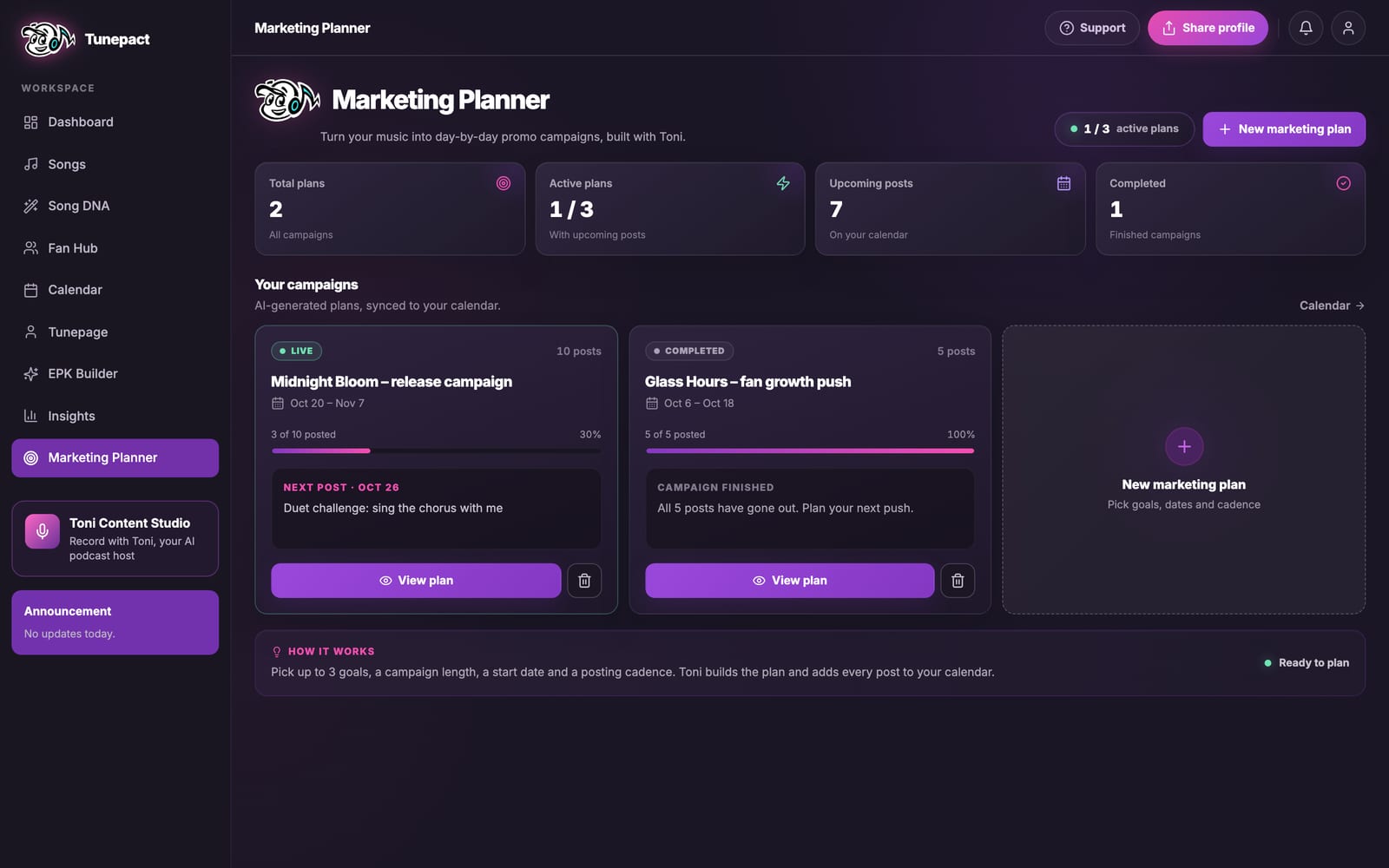
When you're deciding between a flat fee or revenue share, think about your upcoming release schedule and how much marketing muscle you have. The AI Music Marketing Planner helps you assess your release frequency, marketing ambitions, and budget. You can input your upcoming release details to generate a personalized, step-by-step marketing plan.
By seeing the intensity of the marketing plan the planner suggests, you can better determine if you need the extra services a revenue-share distributor often provides (like pitching and promo support) or if you’re confident managing your own marketing with a simpler, flat-fee aggregator. This tool helps you plan your promotional efforts, which in turn helps you project potential earnings. With those projections, you can more accurately evaluate which pricing model will be more profitable for your specific release strategy.
Frequently Asked Questions About Music Distribution Costs
Here are some common questions artists have when navigating distribution pricing.
What's the typical cost for indie music distribution?
The cost varies widely. Flat-fee distributors can range from free (often taking a higher revenue share instead) to around $20–$50 per year for unlimited releases. Revenue-share models typically see distributors taking anywhere from 10% to 30% of your royalties, with no upfront fees.
When does a revenue share model become more expensive than a flat fee?
Mathematically, a revenue share model becomes more expensive when your annual royalties exceed the point where the distributor's percentage cut surpasses the flat fee amount. For example, if a flat fee is $20 per year and the revenue share is 15%, you'd pay more with the revenue share if your annual royalties consistently surpass $133.33 ($20 divided by 0.15). But "expensive" isn't solely about the raw number. It's about the value you get back in services and support that can ultimately boost your overall earnings.
Can I switch distributors if I'm unhappy with my current pricing model?
Yes, you can typically switch distributors, but it requires careful planning. The process usually involves delivering your music to your new distributor first, waiting for it to go live, and then requesting a takedown from your old distributor. This ensures your music remains available and your royalty payments transfer smoothly. Always check your current distributor's terms for their takedown policies.
Do distributors take a cut of my publishing royalties too?
Generally, standard music distributors only take a cut of your sound recording royalties, which are what you earn from streams and sales of the master recording. Publishing royalties, for the underlying composition, are separate. If your distributor offers publishing administration as an additional service, they will typically take a separate percentage of those publishing royalties specifically for that work.