How Independent Musicians Actually Make Money Today
You just got your latest streaming payout statement, and if you’re like most independent artists, it probably feels like a gut punch. You poured your heart into those tracks, spent hours promoting them, and the numbers staring back are barely enough for a few cups of coffee. It’s easy to feel like you’re missing some secret handshake. But here’s the truth: relying solely on streaming income is a losing game for almost everyone. To build a sustainable career, you need to actively cultivate a diverse portfolio of income streams, leaning heavily into direct-to-fan strategies and adopting a genuinely entrepreneurial mindset.
Diversifying Your Income Portfolio Beyond Streaming
The idea that you can just put your music out and the money will roll in from streaming is a myth that keeps too many artists stuck. The reality is that for most independent musicians, streaming revenue alone won't cover your costs, let alone pay your rent. The music industry has shifted, and while streaming is a vital discovery tool, it’s rarely a primary income source for artists outside the top tier. Your goal is not only to get plays, but also to build a robust financial ecosystem around your art.
Think of your music career not as a single river flowing in one direction, but as a watershed with many streams feeding into it. Some streams might be small trickles, others more substantial, but together they create a powerful flow. A recent
highlights how important it is for artists to think broadly about their revenue. This means consciously developing income from different categories: direct-to-fan sales, various types of royalties, licensing, and creative services. If one stream slows down, you’ve got others to keep you afloat. The biggest mistake is putting all your eggs in the streaming basket; it leaves you vulnerable and constantly chasing algorithm changes.
Maximizing Direct-to-Fan Revenue and Engagement
This is where the real power lies for independent artists. Your most engaged fans are your biggest asset, and they are often more than willing to support you directly when given the opportunity.
Building a Strong Fan Community for Sustainable Income
Converting engaged fans into paying customers isn't about tricking them; it's about offering value and exclusive experiences they can’t get anywhere else. Platforms like Bandcamp and Patreon are excellent resources for this. On Bandcamp, you control pricing, bundle deals, and can offer digital downloads, physical merch, and even vinyl. A common mistake artists make is treating Bandcamp like just another streaming platform. Instead, use it as your storefront.
For example, when you release a new single, instead of just putting it on Spotify, release it on Bandcamp first with an exclusive B-side or a demo track. Price the single at $2, and encourage fans to pay more if they want. You’d be surprised how many will. Patreon takes this a step further, allowing you to create subscription tiers. You could offer a $5/month tier for early access to songs and behind-the-scenes content, a $15/month tier for exclusive Discord access and monthly Q&As, and a $50/month tier for personalized song snippets or private virtual concerts. The key is consistent communication and delivering on your promises for each tier. Don't just set it up and forget it; actively engage with your patrons.
Mastering Merchandise and Physical Sales for Profit
Mastering Merchandise and Physical Sales for Profit Merchandise is not only about branding, but also a significant revenue driver and a tangible way for fans to show their support. Think beyond just T-shirts. While a well-designed tee is great, consider items that genuinely reflect your brand and offer utility or uniqueness. Limited edition vinyl, custom-designed patches, art prints inspired by your lyrics, or even unique experiences like a personalized handwritten lyric sheet can command higher prices and create deeper connections.
When it comes to pricing, don't undersell yourself. Calculate your production costs, add a reasonable profit margin, and then consider what your fans would pay for something unique. A good rule of thumb is to aim for at least a 2x-3x markup on your cost of goods. For fulfillment, you can start by handling it yourself for a more personal touch, but as you grow, look into print-on-demand services or fulfillment partners to save time. For more in-depth strategies, check out our guide on
. The biggest pitfall here is ordering too much inventory upfront for an unproven product, so start small, test demand, and scale up.
Tunepact tip: Get a personalized, step-by-step marketing plan for your next release. Plan your release →
Navigating and Boosting Your Music Royalties
While direct-to-fan income is often more immediate and controllable, royalties are still an important part of your overall income. It just requires understanding how they work and being diligent in collecting them.
Understanding Performance, Mechanical, and Sync Royalties
There are several types of royalties you need to be aware of. **Performance royalties** are generated whenever your music is performed publicly, whether that’s on radio, TV, in a live venue, or even played in a restaurant. These are collected by Performance Rights Organizations (PROs) like ASCAP, BMI, or SESAC. **Mechanical royalties** are generated every time your song is reproduced, whether that's on a CD, vinyl, digital download, or even streamed on-demand. **Sync royalties** (synchronization royalties) are paid when your music is used in conjunction with visual media, like films, TV shows, commercials, or video games. Each type has its own collection mechanism.
Essential Collection Societies and Platforms for Indies
To claim your due, you need to register your music correctly. For performance royalties, register your songs with a PRO as both a songwriter and a publisher. Even if you don't have a formal publishing company, you generally act as your own publisher. For mechanical royalties, in the US, the Mechanical Licensing Collective (MLC) collects and distributes these for streams. Your distributor (like DistroKid or TuneCore) usually handles the initial mechanical licensing for digital releases, but it's important to make sure your works are properly registered with the MLC directly or through your publisher. Many artists miss out on significant mechanical royalties by not doing this. We have a detailed guide on how to
that walks you through the process.
A common pitfall is assuming your distributor handles everything. While they do a lot, you still need to actively register with your PRO and ensure your works are properly registered elsewhere. Don't leave money on the table. To learn more about maximizing your earnings, explore
. And for a realistic look at streaming income, check out the
, which outlines how payouts work directly from the source. The situation is always changing; for instance, the
often gives insights into industry shifts that affect royalty streams.
Creative Monetization Through Licensing, Sync, and Beyond

Beyond the traditional avenues, there's a whole world of creative ways to make money from your music and your skills.
Sync licensing can be incredibly lucrative. Getting your song placed in a TV show, film, commercial, or video game can provide a significant one-time fee and ongoing performance royalties. This often requires having high-quality, well-produced tracks, instrumental versions, and clear metadata. You can pitch directly to music supervisors, use licensing libraries (like Musicbed or AudioJungle), or work with sync agents. Starting with smaller, independent film projects or YouTube creators can be a great way to build a portfolio and get your first placements.
Another avenue is creating library music, also known as production music or stock music. This is music specifically created to be licensed for various media projects. While individual licenses might be smaller, the volume can add up, creating a steady passive income stream. Furthermore, look for brand partnerships that align with your artistic values. A local coffee shop might want your music to play in their store, or a small clothing brand might want to feature your track in their online ads. These don't always pay huge sums, but they can offer exposure and build relationships. The
blog from MIDiA Research often touches on these evolving opportunities for artists.
Don't forget your skills beyond just songwriting and performing. Many musicians teach private lessons, lead workshops on songwriting or music production, or offer commissioned work for jingles, custom scores, or even personalized songs for special occasions. These skills are valuable and can provide a flexible income stream that directly uses your expertise.
Using AI Tools to Strategize Your Revenue Growth
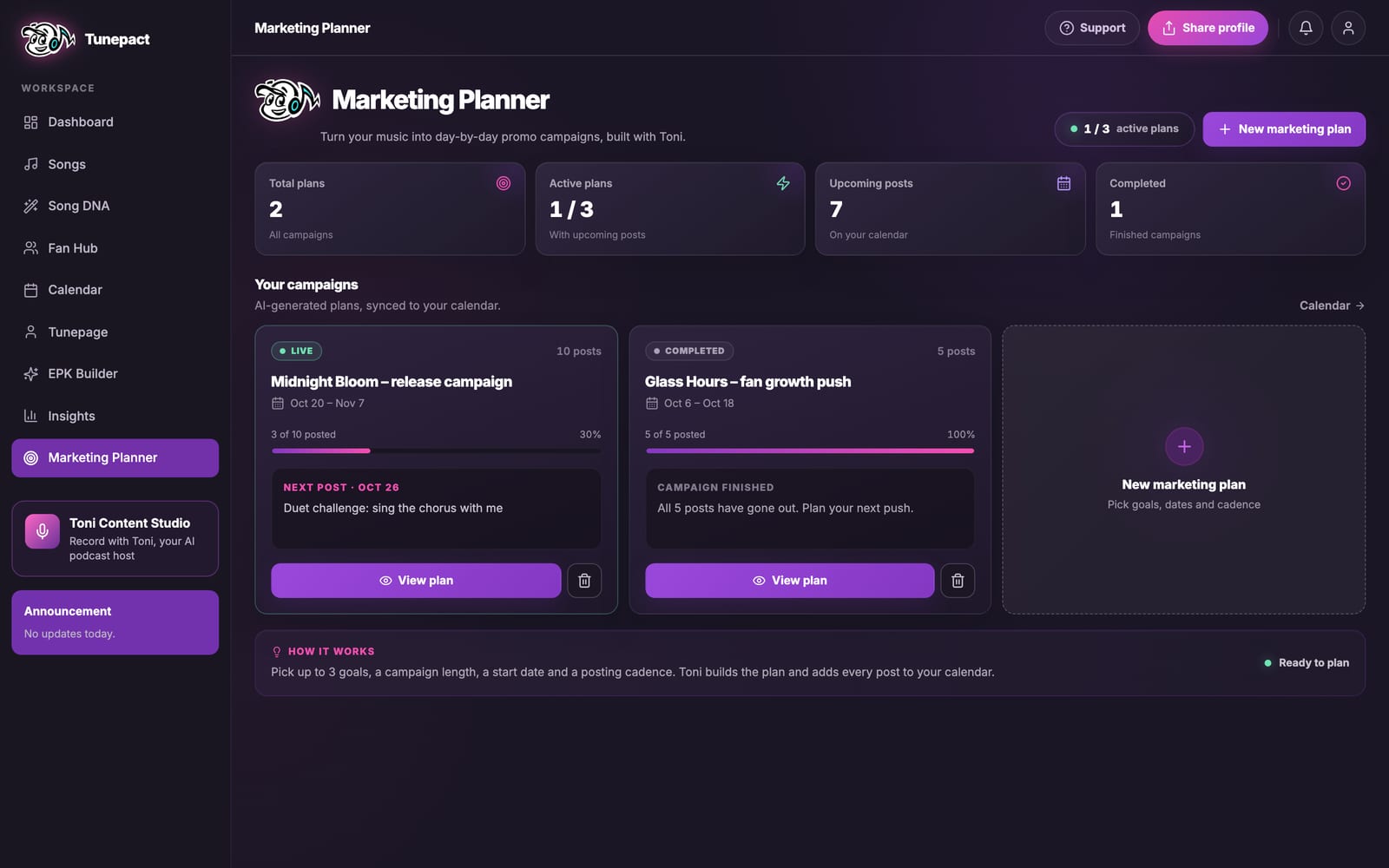
With so many potential income streams, it can feel overwhelming to figure out where to focus your energy. This is where smart tools can make a real difference.
The Tunepact
can help you cut through the noise and build a cohesive strategy for your various income goals. It generates a personalized, step-by-step marketing plan for your next release or project. Let's say you're looking to launch a new, higher-tier Patreon offering to boost your direct-to-fan income. You might input details about your new "exclusive demo club" tier, your target audience, and your desired launch date. The planner won't just tell you to promote it; it might suggest specific content ideas for social media leading up to the launch, email campaign sequences for your existing fans, and even ideas for exclusive content teasers to build hype. It helps you map out your marketing activities, ensuring they directly support your monetization goals, rather than just throwing content out there hoping something sticks. For a broader look at tools that can help your music career, explore our list of
.
Building a Sustainable Independent Artist Business Model
Ultimately, making money as an independent musician means treating your art like a business. This doesn't diminish the art; it makes it stronger.
Financial Planning and Goal Setting for Musicians
You need a basic understanding of your finances. This means tracking your income from all sources and diligently tracking your expenses (recording costs, marketing, gear, travel). A simple spreadsheet can do wonders here. Set realistic financial goals. Instead of "I want to be rich," aim for "I want to earn $500 this month from direct-to-fan sales" or "I want to generate enough income to cover my studio time by the end of the quarter." Once you start earning, create a system for reinvesting a portion of your earnings back into your career. That might mean saving for a better microphone, hiring a mixing engineer, or investing in targeted ads. This is not only about making money, but also about creating a cycle of growth.
Adopting an Entrepreneurial Mindset for Longevity
The biggest shift you can make is adopting an entrepreneurial mindset. This means being proactive, identifying opportunities, learning new skills (like basic marketing, graphic design, or video editing), and being resilient in the face of setbacks. Think of yourself as a small business owner whose product is your music and your brand. This involves constantly analyzing what’s working and what isn’t, experimenting with new approaches, and building relationships. It means understanding that your art is valuable, and you deserve to be compensated fairly for it. This is more than just a hobby; it is your career, and treating it as such is the first step toward true financial stability.
Frequently Asked Questions
How much do independent musicians typically earn from streaming?
Independent musicians typically earn very little from streaming directly, often fractions of a cent per stream, meaning it takes millions of streams to generate significant income. For most, streaming serves more as a discovery and distribution platform than a primary revenue source.
What are the most profitable revenue streams for indie artists right now?
The most profitable revenue streams for indie artists right now are generally direct-to-fan sales (merchandise, Bandcamp, Patreon subscriptions) and sync licensing, as these offer higher per-unit revenue and more direct control. Live performances can also be highly profitable when managed well.
How can I effectively build a direct-to-fan income stream without a huge following?
You can effectively build a direct-to-fan income stream without a huge following by focusing on deep engagement with your existing fans, no matter how small the number. Offer exclusive content, personalized experiences, and unique merchandise that makes them feel valued and part of your journey, often through platforms like Patreon or Bandcamp.
Should I focus on one revenue stream or diversify immediately as a new artist?
As a new artist, you should aim to diversify your revenue streams as soon as possible, even if you start small. While you might focus more heavily on one or two initially, having multiple income sources provides stability and resilience, ensuring you're not solely reliant on any single unpredictable channel.