Navigating AI Music Distribution: An Evolving Approach
Get your plan straight before you distribute
The rules around AI are new, but your responsibility isn't. You can't just upload a track with AI elements and assume it's fine. Distributors and Digital Service Providers (DSPs) are looking for this now, and they have questions. Your job is to have the answers ready before you hit 'submit'.
Read the rules for your distributor and platforms
First, stop guessing. Go read the terms of service for your distributor and the big platforms they deliver to. They all have new guidelines, and they are not all the same. Look for their pages on "AI-generated content" or "synthetic media."
One platform might just want you to tick a box. Another might ask for the percentage of the track that's AI-generated. You have to know which is which. Find the page, read it, and save a link. This is boring work, but it will save you from a rejection email later.
Why tracks with AI get rejected
DSPs reject tracks with AI for a few predictable reasons. The most common is simply not telling them you used it. But they also reject music when you can't prove you have the legal right to use the AI's output, or when the AI-generated part sounds like it infringes on someone else's copyright.
A big mistake is using an AI tool that was trained on copyrighted music without a proper license. It's on you to make sure any tool you use creates output that is clear for commercial release. If you're choosing a distributor, check their AI policies first; this guide to indie music distributors can help you compare them.
Own your work, and know what you can't own
This is where artists get stuck. Just because an AI made a sound doesn't mean you own it or can sell it. You need to be very clear about what you created versus what the machine did.
Prove a human did the work
The U.S. Copyright Office has a straightforward position: a work needs a human author to be copyrightable. If you just type "make a sad pop song" and upload what comes out, you can't copyright it. But if you use AI as a tool—if you take its output, chop it up, add your own melody, write lyrics over it, and arrange it into a full song—then your creative work can be copyrighted.
Think of it like a sampler. You didn't invent the original sound, but the new piece of music you create with it is yours. You have to show your contribution went beyond merely pressing a button. The official U.S. Copyright Office Guidance on AI-Generated Material is surprisingly readable and explains what counts as human authorship.
Check the AI tool's license before you create
Before you even start a project, read the terms of service for the AI tool you're using. The license will tell you if you can use the output in a song you plan to sell. Some tools give you a clear commercial license, but others might restrict it or require a paid subscription. Don't get attached to a sound you can't legally release.
If you use AI-generated loops or samples, treat them just like any other sample: clear the rights first. Doing this homework protects you and your ability to collect your music royalties.
Tunepact tip: Get a personalized, step-by-step marketing plan for your next release. Plan your release →
Be honest about using AI
This isn't complicated. Just be upfront about using AI. It keeps you on the right side of your distributor's rules and, more importantly, it's honest. Don't hide it; explain it.
What happens if you don't disclose
Besides just being the right thing to do, disclosure is a practical necessity. Platforms are actively scanning for AI-generated content. If they find it in your track and you didn't declare it, they can take your music down. It's much easier to be proactive.
And from a fan's point of view, knowing how a track was made is interesting. It's part of the story of the song. When you're looking at your options, you can compare TunePact with Symphonic and see how different services approach transparency.
How to disclose your AI use
So, where do you do it? Start with your metadata when you upload. Your distributor should have a specific field or checkbox for AI. Be precise. Don't just say "AI used." Say "AI-generated drum loop" or "Vocal harmony generated by AI."
Then, tell your fans. You don't need a huge disclaimer, just be matter-of-fact. A simple post on social media could be, "For the new track, I used an AI to create the initial synth arpeggio, then built the rest of the song around it." This frames AI as another tool in your studio, which is exactly what it is.
Marketing your AI-assisted music

You've done the work to get your track cleared and distributed. Now you need to get people to hear it and make sure you get paid.
Getting paid for your tracks
The way you make money is the same: royalties from streams, downloads, and sync placements. The only difference with AI is that if your track gets taken down for a compliance issue, your income stops. The most important thing is to make sure your track is properly registered and follows all the rules so it stays live.
And of course, making good music still matters more than anything. A tool is only a tool. You can learn more about how platforms are using AI in promotion, like by mastering Spotify’s new AI chatbot.
How to talk about AI in your promotion
Be as real in your promotion as you are in your music. Don't just post "new song out now." Tell the story. "I was stuck on the bridge for this new song, so I fed the chords into an AI harmony generator and it sparked the idea for the final melody. Here's how it turned out." That's interesting. It pulls people into your creative process.
Don't pretend you didn't use it, and don't pretend the AI wrote the whole song for you. Just tell the truth. To get more ideas, you can start by understanding AI music marketing.
Plan your release with the AI Music Marketing Planner
Juggling all the steps for a release, especially one with AI, is a lot. The Tunepact AI Music Marketing Planner can help. It provides a personalized, step-by-step marketing plan for your next release.
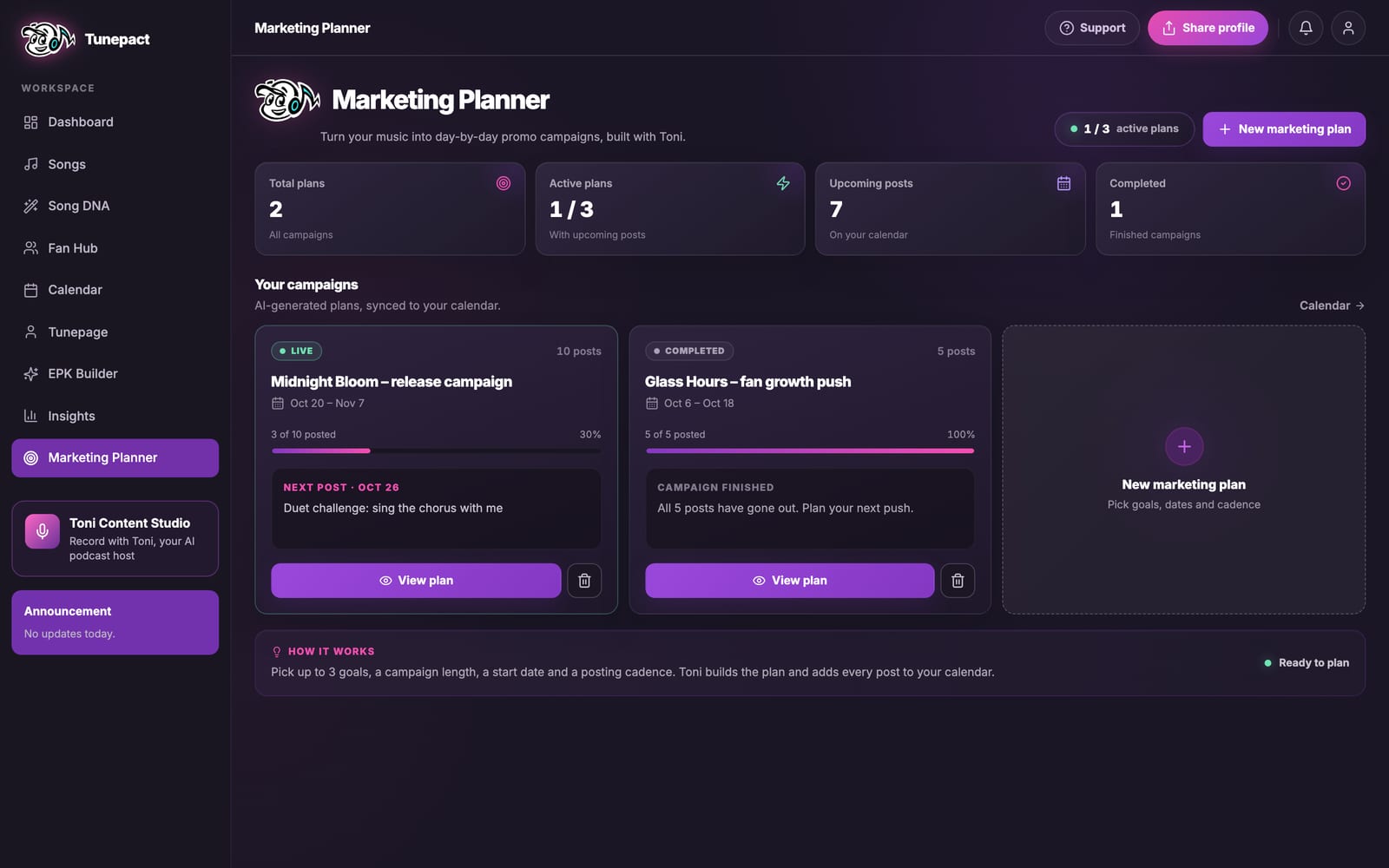
You can use the planner to clearly define your release goals and pinpoint your target audience for your AI-assisted music. It helps you build those disclosure and licensing checks into your timeline, so you don't forget them.
The planner will give you a promotional schedule for your AI-enhanced tracks, from building buzz before the release to keeping listeners engaged after, all while keeping compliance and transparency front and center. Get your personalized plan today at the AI Music Marketing Planner.
Frequently Asked Questions about AI Music Distribution
Can I copyright music made with AI, and what are the requirements?
Yes, but only the parts where you, as a human, exercised creative control. The U.S. Copyright Office requires a significant human contribution for a work to be eligible for copyright. Simply generating music with a prompt and uploading it won't qualify, but shaping, arranging, or significantly modifying AI-generated elements with your own artistic input can.
Will DSPs automatically reject my song if it contains AI-generated elements?
Not automatically, but they might if you don't follow their specific guidelines. DSPs are increasingly requiring clear disclosure of AI use in metadata. If they detect AI and you haven't declared it, or if the AI content infringes on existing copyrights, your song could be rejected or removed. It all comes down to being transparent and following their rules.
Do I legally need to disclose if I used AI in my music production?
While there isn't a universal law that says you must, many distributors and DSPs now require it in their terms of service. If you don't disclose, you risk having your music removed or your account penalized. The smart move is to disclose for both compliance and transparency.
How can I find AI music generation tools that are properly licensed for commercial use?
Look for AI music tools that explicitly state in their terms of service that their output can be used for commercial purposes. Reputable tools will have clear licensing agreements, often with different tiers for personal versus commercial use. Always read the fine print about intellectual property rights, attribution, and whether the AI model was trained on legally acquired data.