Music Copyright: Protecting Your Songs & How to Copyright Them
As an independent musician, your music is your most valuable asset. It's the product of your creativity, hard work, and unique artistic vision. But how do you ensure that this invaluable creation is legally protected, allowing you to control its use and earn the royalties you deserve? The answer lies in understanding and leveraging music copyright.
This comprehensive guide from TunePact will break down the complexities of music copyright, offering a practical, step-by-step approach for independent artists to safeguard their work, distinguish between different types of rights, and maximize their potential earnings in the dynamic music industry.
Introduction: Why Music Copyright Matters for Independent Artists
In today's digital landscape, where music can travel globally in an instant, understanding and protecting your intellectual property is more crucial than ever. For independent artists, neglecting copyright can lead to significant financial losses, unauthorized use of your work, and a diminished ability to build a sustainable career.
The Complex World of Music Rights Made Simple
The music industry often feels like a maze of legal jargon and intricate agreements. However, at its core, music copyright is about asserting ownership over your creations. By simplifying these concepts, TunePact aims to empower you with the knowledge to navigate this world confidently.
Proper copyright management is the foundation upon which all your licensing opportunities and royalty streams are built. Without it, your unique compositions and recordings are vulnerable.
Empowering Your Career: Protection and Profit
For independent musicians, understanding music copyright for independent artists isn't just a legal formality; it's a strategic business move. It ensures that you, the creator, retain control over your art, dictate how it's used, and most importantly, get paid for it.
This article will provide you with a clear, actionable roadmap on how to copyright a song, helping you protect your intellectual property and secure your financial future in music. For a deeper dive into the financial aspects, explore our guide on Music Publishing Unlocked: Royalties, Copyrights & Deals for Independent Artists.
Understanding Music Copyright: Master Recording vs. Composition Copyright
Before diving into registration, it's essential to grasp the fundamental distinction that underpins all music rights: the difference between a musical composition and a sound recording.
Music copyright legally designates ownership of a musical work, granting the owner exclusive rights to reproduce, distribute, perform, display, and create derivative works. This ownership is the bedrock of earning money from your music.
The Two Distinct Copyrights in Every Song
When you hear a song, you're actually experiencing two separate, yet intertwined, copyrighted works. This concept of two distinct copyrights is vital for any independent artist to understand, as it dictates who owns what and who gets paid for which uses.
To fully grasp the complexities of these rights, it's helpful to understand Master Rights vs. Publishing: Essential Music Rights for Independent Artists. This distinction is crucial for protecting your work.
Compositional Copyright: Protecting the Song Itself
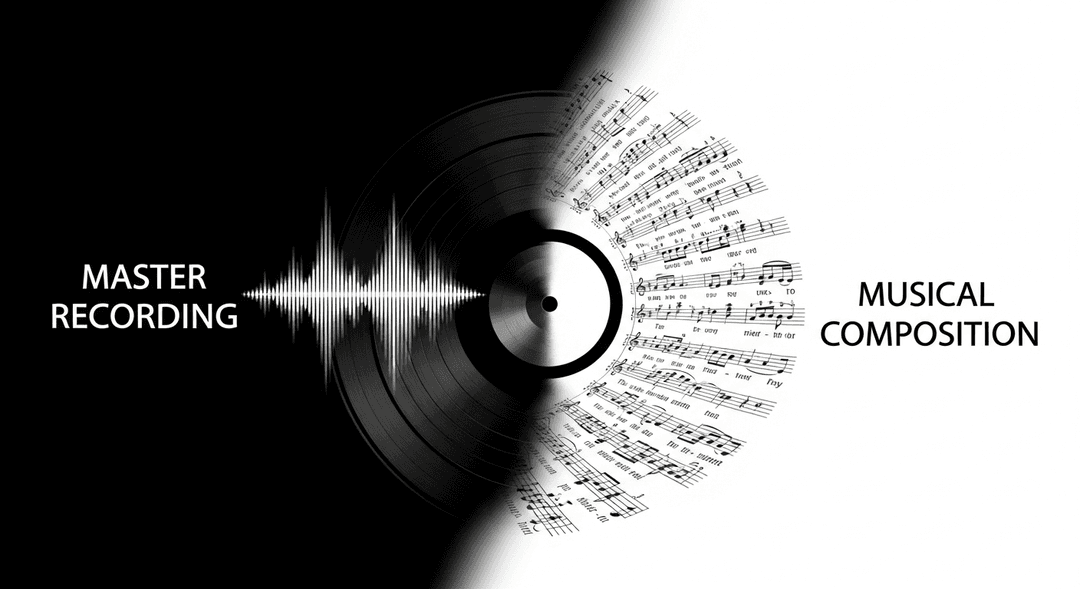
The compositional copyright protects the underlying musical work – the melody, harmony, rhythm, and lyrics. This is the abstract creation that could be performed by anyone, in any style, with any instrumentation. It's the sheet music, the lyrics written on paper, the core idea of the song.
Typically, the songwriter(s) and lyricist(s) own the compositional copyright. If you're an artist who also writes your own music, you own this right. This copyright is often managed by music publishers who help license the composition and collect royalties on behalf of the songwriters.
Master Recording Copyright: Protecting the Performance
The master recording copyright, or sound recording copyright, protects the specific recorded performance of a song. This includes the unique interpretation, arrangement, sound engineering, and production choices that make that particular recording distinct. It's the actual sound file you listen to on streaming services, CDs, or vinyl.
The owner of the master recording is usually the artist (if self-releasing) or the record label that funded and produced the recording. This copyright gives you control over how your specific recording is reproduced and distributed. Understanding this key difference between master recording vs composition copyright is fundamental for effective rights management.
For an in-depth look at these concepts and their implications for licensing, the ICMP London: Understanding Music Copyrights and Licenses provides excellent insights.
How to Copyright a Song: A Step-by-Step Guide for Music Copyright Registration
While copyright exists from the moment your original work is fixed in a tangible form (e.g., recorded or written down), formal registration provides significant legal advantages. This section will guide you through the process of music copyright registration, primarily focusing on the U.S. Copyright Office as a common example.
Preparation: What You Need Before You Register
Before you begin the registration process, gather all necessary information and materials. This preparation will streamline your application and prevent common errors.
- A Completed Work: Your song must be "fixed in a tangible medium of expression." This means it needs to be recorded (audio file) or written down (sheet music, lyrics).
- Identifying Information: Your full legal name, address, and contact information. If you're registering as a group or company, provide that information.
- Authorship Details: Clearly identify who wrote the music and lyrics. If there are collaborators, list them.
- Deposit Copy: A copy of the work you want to register. For music, this is typically an audio file (MP3, WAV) and/or a lead sheet with lyrics and melody.
Navigating the U.S. Copyright Office Process
The U.S. Copyright Office website (copyright.gov) is where you'll submit your application. The process is primarily online and relatively straightforward once you understand the steps.
- Create an Account: If you don't have one, register for an account on the U.S. Copyright Office's eCO (electronic Copyright Office) system.
- Select Your Application Type: You'll typically choose "Register a musical work" or "Register a sound recording." Remember the distinction between composition and master! You might need to file two separate applications if you own both rights and want maximum protection for both. However, you can register a "Work of the Performing Arts" that combines both the musical composition and the sound recording on a single application if you are the sole author/copyright claimant of both.
- Fill Out the Application Form: Provide all requested details, including titles, authors, claimants, and any previous registrations. Be accurate and thorough.
- Upload Your Deposit Copy: Attach your audio files, lyric sheets, or sheet music as required.
- Pay the Fee: A non-refundable filing fee is required for each application.
- Review and Submit: Carefully review all information before submitting. Errors can delay the process.
For a more detailed walkthrough, the Berklee Online Guide: How to Copyright a Song offers an excellent resource.
The Benefits of Formal Registration for Independent Artists
While copyright protection exists automatically, formal registration provides crucial legal benefits:
- Public Record: It creates a public record of your copyright claim.
- Ability to Sue: You cannot file an infringement lawsuit in federal court without a registered copyright.
- Statutory Damages & Attorney's Fees: If registered in a timely manner (before infringement or within 3 months of publication), you can claim statutory damages and attorney's fees in a successful infringement suit, which can be significantly higher than actual damages. This serves as a strong deterrent against unauthorized use.
- Evidence in Court: It provides prima facie evidence of the validity of your copyright and the facts stated in the certificate.
Avoiding common mistakes during this process is key. Learn more about Top Mistakes Artists Make When Registering Songs for Royalties to ensure you're doing it right.
Protecting Your Music Rights: Beyond Formal Registration
Formal registration is a cornerstone of protecting your music rights, but it's not the only step. Independent artists should also employ practical strategies to assert ownership and deter infringement, both before and after registration.
Establishing Ownership: Copyright Notices and Metadata
Proactive measures can help establish and communicate your ownership rights effectively:
- Copyright Notices (©): Always include a copyright notice on your music. For compositions, use "© [Year of Creation] [Your Name/Publisher Name]". For sound recordings, use "℗ [Year of First Publication] [Your Name/Label Name]". This notice serves as a clear warning to potential infringers.
- Metadata Embedding: When distributing digital music, embed crucial information into the audio files themselves. This includes song title, artist name, album, year, genre, and most importantly, copyright owner details. Many digital distribution services allow you to add this metadata, which travels with your music.
- Digital Watermarking: Some advanced tools offer digital watermarking, subtly embedding identifying information into the audio waveform, making it harder to remove even if the file is altered.
Monitoring for Infringement and Taking Action
The digital age makes it easier for your music to spread, but also easier for it to be misused. Vigilance is key:
- Regular Monitoring: Use tools like Google Alerts, YouTube's Content ID, and social media searches to monitor for unauthorized uses of your music.
- DMCA Takedown Notices: If you find unauthorized use, especially on platforms like YouTube, Facebook, or SoundCloud, you can issue a Digital Millennium Copyright Act (DMCA) takedown notice. Most platforms have a process for this.
- Cease and Desist Letters: For more persistent or blatant infringement, a formal cease and desist letter from an attorney can often resolve the issue without needing to go to court.
The Importance of Clear Agreements and Contracts
Many copyright disputes arise from unclear agreements between collaborators. Protect yourself by formalizing all relationships:
- Collaboration Agreements: If you co-write a song, create a written agreement specifying ownership percentages for the composition, how royalties will be split, and decision-making authority.
- Producer Agreements: If you work with a producer, clarify whether they have any ownership in the composition or master, or if they are simply being paid for their services.
- Sample Clearances: If you use samples in your music, ensure you have properly licensed and cleared them. Failing to do so can lead to costly infringement claims. TunePact's Guide to Leased Beats, Sync Deals, and Music Rights offers further insights into proper clearances.
Monetizing Your Music: How Copyrights Fuel Royalties and Licensing Explained
The ultimate goal of protecting your music rights is to ensure you can earn a living from your art. Your copyrights are the engine that drives your income, enabling you to collect various types of royalties and secure lucrative licensing opportunities.
Understanding Different Royalty Streams for Your Music
Copyrights allow you to generate income through several distinct royalty streams, each tied to specific uses of your music:
- Performance Royalties: Paid when your composition is performed publicly (radio, TV, venues, streaming services). These are collected by Performance Rights Organizations (PROs).
- Mechanical Royalties: Paid when your composition is reproduced (e.g., downloaded, streamed interactively, pressed onto CDs/vinyl).
- Synchronization (Sync) Royalties: Paid when your composition and/or master recording is used in visual media (film, TV, commercials, video games).
- Print Royalties: Paid when sheet music or lyrics of your composition are reproduced.
- Digital Performance Royalties: Paid to master recording owners when their sound recordings are performed on non-interactive digital services (e.g., Pandora, SiriusXM). These are collected by SoundExchange in the U.S.
Understanding What Are Performance Royalties? An Indie Artist's Playbook is a great starting point for unlocking these income streams.
The Role of PROs and Collection Agencies
You don't collect all these royalties directly. Various organizations are responsible for tracking usage and distributing funds:
- Performance Rights Organizations (PROs): In the U.S., ASCAP, BMI, and SESAC collect performance royalties for songwriters and publishers.
- Mechanical Rights Organizations (MROs): The Mechanical Licensing Collective (MLC) in the U.S. collects and distributes mechanical royalties for compositions.
- SoundExchange: This organization collects and distributes digital performance royalties for sound recording owners and featured artists in the U.S.
- Publishing Administrators: Companies that help independent artists register their songs globally and collect various royalties from PROs and MROs, taking a percentage for their services.
Registering your works with the appropriate collection societies is a critical step in ensuring you get paid for every use of your music. This makes music publishing explained an important topic for all artists.
Unlocking Opportunities Through Sync Licensing
Sync licensing is a powerful way for independent artists to gain exposure and significant income. When your music is licensed for a film, TV show, commercial, or video game, both the owner of the composition and the owner of the master recording receive a sync fee.
Clear copyright ownership and proper registration make your music an attractive asset for music supervisors. They need to know they can easily clear the rights without legal complications. The RIAA: Music Licensing Resources provides valuable information on the various types of licenses involved in monetizing your music.
Common Pitfalls: Mistakes Independent Artists Make with Music Copyright
Even with good intentions, independent artists can inadvertently make mistakes that compromise their copyright protection and potential earnings. Awareness of these pitfalls is the first step toward avoiding them.
Delaying or Skipping Registration Entirely
One of the most frequent and damaging errors is failing to formally register your copyright, or waiting too long to do so. As discussed, while copyright technically exists upon creation, registration offers irreplaceable legal benefits, especially the ability to sue for infringement and claim statutory damages.
Many artists mistakenly believe that the "poor man's copyright" (mailing a copy to yourself) is sufficient, which it is not. Others simply procrastinate, only to find their music infringed upon without the strong legal standing that registration provides.
Confusing Rights and Ownership
The distinction between compositional and master recording copyright can be confusing, leading to improper registration or disputes. Forgetting to register both, or incorrectly identifying ownership in collaborative works, can create significant headaches down the line.
For instance, if you produce a beat for another artist, clarify in writing whether you retain any publishing share in the composition or solely a producer fee for the master. Clear communication and contracts prevent these misunderstandings.
Neglecting International Protections
While U.S. copyright registration primarily protects you within the United States, international agreements like the Berne Convention mean that your copyright is generally recognized in most other member countries. However, enforcing those rights can be complex.
Independent artists often overlook the nuances of international copyright, especially when their music gains traction abroad. For significant international success, consulting with intellectual property lawyers specializing in international law might become necessary.
To further understand and avoid these types of missteps, review our article on Top Mistakes Artists Make When Registering Songs for Royalties.
Frequently Asked Questions about Music Copyright
To further clarify common concerns, here are answers to some frequently asked questions about music copyright for independent artists.
How much does it cost to copyright a song in the U.S.?
The filing fee for registering a single work online with the U.S. Copyright Office is generally around $45-$65, depending on the application type and whether you are registering a single work or a collection. This fee covers the processing of your application, but does not include any legal fees if you choose to consult with an attorney.
Do I need to copyright each version or recording of my song separately?
Generally, yes, if you want maximum protection for both. The musical composition (melody, lyrics) and each distinct sound recording (master) are separate copyrighted works. If you are the sole author and claimant of both the composition and the sound recording, you can often register them together as a "Work of the Performing Arts" with a single application. However, if you have multiple distinct recordings of the same composition, or if different people own the composition vs. the master, separate registrations are typically required for each distinct work you wish to protect.
What's the main difference between a master recording copyright and a musical composition copyright?
The musical composition copyright protects the underlying song itself – the notes, lyrics, and arrangement. It's owned by the songwriter(s) and publisher(s). The master recording copyright protects the specific recorded performance of that song – the actual audio file. It's owned by the artist (if self-released) or the record label. Think of it this way: the composition is the blueprint, and the master recording is the finished building.
How long does music copyright protection last?
In the United States, for works created on or after January 1, 1978, copyright protection generally lasts for the life of the author plus 70 years. If the work is a "work made for hire" or published anonymously/pseudonymously, the term is 95 years from first publication or 120 years from creation, whichever is shorter. After this period, the work enters the public domain.