Electronic Press Kit Examples: Designs That Win Opportunities
You’re about to send that email, the one to the booker of your dream venue or that blog you read every day. You've got it all drafted, but then you pause at the part where you link to your press kit. You click the link one last time, and what you see feels more like a messy folder of files than a professional pitch. Most artists treat their EPK like a digital storage unit for their bio, photos, and songs. That’s a mistake. A great EPK isn't a storage unit; it's a sharp, persuasive tool built to get a specific person to say "yes."
Give Them Everything They Need, Nothing They Don't
Think of your EPK as your professional handshake. It needs to give bookers, journalists, and curators everything they need without making them dig for it. That means a compelling bio, your best music, high-quality photos, engaging videos, relevant press mentions, and clear contact information. Each piece plays a role in telling your story and proving you’re a pro.
A venue booker might only glance at your music player and photos first. If those grab them, they'll read your bio. A blog editor might head straight for your press quotes to see if you're already gaining traction. You need to make sure every element is easy to find and presents you in the best light. When your EPK is well-structured, they don't have to hunt for your best song or a high-res photo, which drastically increases your chances of getting a second look. If you're wondering about the basics, this guide on
can help clarify the essentials. It's about making their job easier. For another perspective, you might find this article from
useful.
Your EPK's Design Should Do Work for You
Even with all the right content, a poorly designed EPK can fall flat. A messy presentation suggests a messy artist. Your EPK needs to be visually cohesive and easy to navigate, guiding the viewer through your story and achievements.
Keep Your Visuals Consistent
Your EPK should look and feel like an extension of your artistic identity. This means using your band's logo, consistent color schemes, and fonts that align with your overall brand. If your music is dark and moody, don't use bright, bubbly pastels in your EPK. If your album art and social media have a specific look—say, grainy black-and-white photos and a classic serif font—your EPK should use that same style. That visual thread tells industry pros you’re serious about your art. For more ideas on how to make your online presence work, check out these
.
Make It Easy for Them to Find Things
Industry professionals are busy. They need to find information quickly. Your EPK should have clear headings, logical sections, and minimal clutter. Don't make them scroll endlessly or click through multiple pages to find your music or contact details. Keep your most important elements visible without scrolling, especially your bio, a music player, and key contact info.
A good EPK might have a clear menu or anchor links at the top: Bio, Music, Photos, Videos, Press, Contact. Each section should be distinct. And ensure your EPK loads quickly on both desktop and mobile devices. Many people will open your kit on their phone while standing in a loud venue. If it's a jumbled mess, they'll close it.
It has to work on mobile.
Think about how you designed your main artist website, especially the homepage. The same principles apply here; if you need a refresher, our post on
offers great insights that transfer directly to EPK design.
Fill Your EPK with Your Best Work
The design gets them in the door, but the content is what keeps them there. This is where you tell your story, showcase your talent, and prove your worth.
Writing a Compelling Artist Bio
Your bio is your story, not just a list of facts. It should be concise, engaging, and highlight what makes you unique. Start with a strong hook that captures your sound or story, then briefly cover your achievements or notable influences. Keep it to two or three short paragraphs. You should have different versions: a one-sentence tagline, a short paragraph (about 100 words), and a longer one (about 250 words) for different purposes.
Here's a common mistake: writing a bio that reads like a Wikipedia entry. Instead, focus on your "why." For example, instead of "Jane Doe is a singer-songwriter from Austin, Texas," try: "Jane Doe crafts haunting folk-pop anthems born from late-night drives through the Texas hill country, blending raw lyricism with a voice that commands attention." This immediately sets a mood and piques interest.
Showcasing Your Best Music and Videos
Don't include your entire discography. Curate. Pick your absolute strongest two or three tracks that best represent your sound. These should be high-quality, fully mixed, and mastered. Embed them directly into the EPK with a clear player, rather than just linking out to Spotify. The same goes for videos: select your best music video, a compelling live performance clip, or a short, professional behind-the-scenes piece. One well-produced video is better than three shaky phone recordings.
Curating Your Press & Achievements
This section builds credibility. Include quotes from reviews, articles, or testimonials from industry professionals. Don't just list every mention; pick the most impactful ones. A quote from a respected blog or a mention of a notable festival performance carries more weight than a local paper's brief blurb. If you don't have much press yet, you can include strong testimonials from mentors, collaborators, or even respected local figures who can speak to your talent and work ethic. For more on building these core components, this guide from
provides a good overview.
A Tool to Build Your EPK
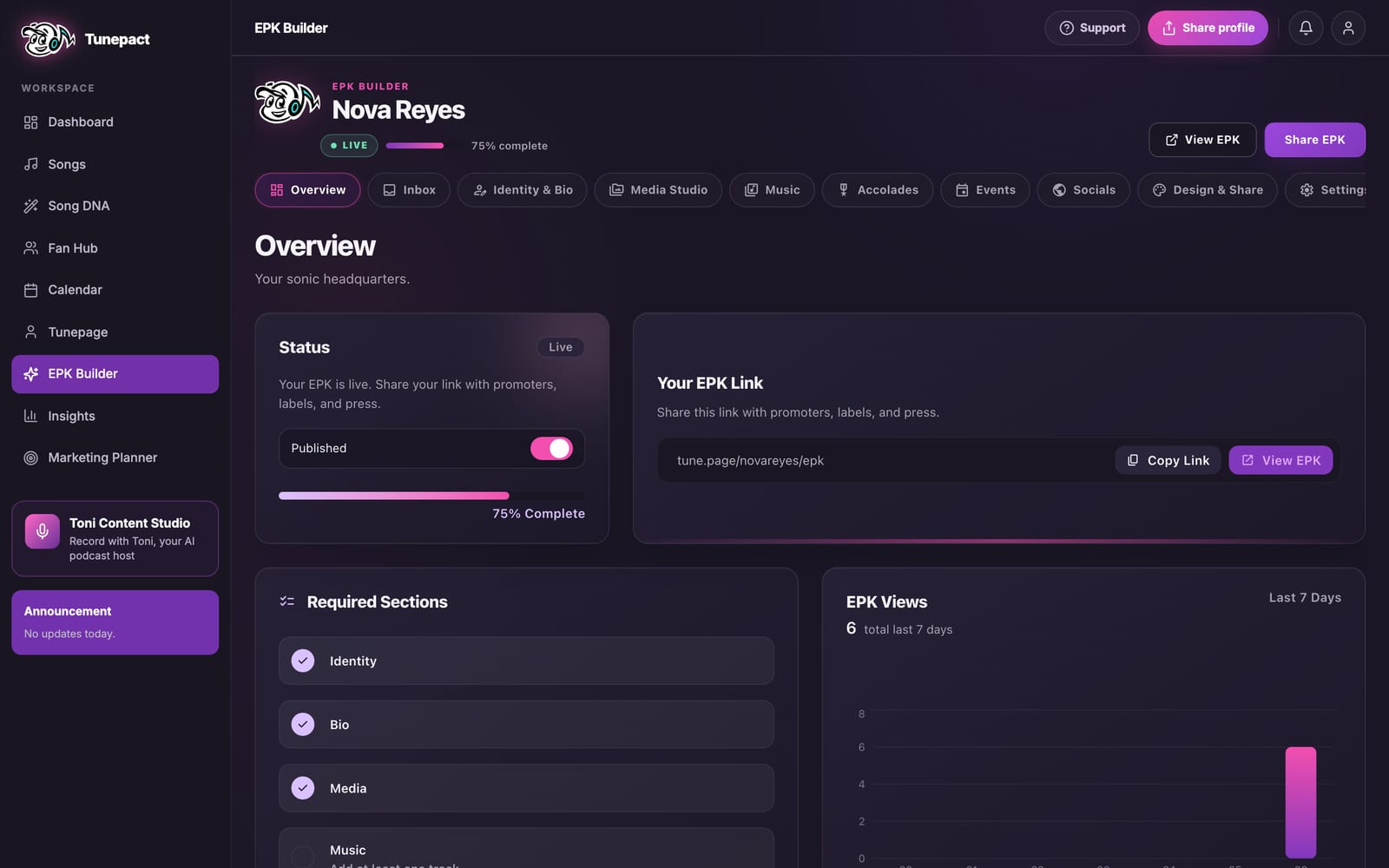
Putting all these pieces together can feel like a huge task, especially when you're managing everything else as an independent artist. TunePact's EPK Builder is a tool that simplifies this process. It provides ready-made templates and a user-friendly interface so you can easily upload your bio, music, photos, videos, and press clippings. You don't need design skills to create a polished, shareable EPK that's optimized for industry outreach. It helps you assemble all the necessary components quickly, ensuring your kit is professional and ready to send. Check it out and see how easy it can be to build your own with
.
How to Use Your EPK to Land Gigs and Media Features
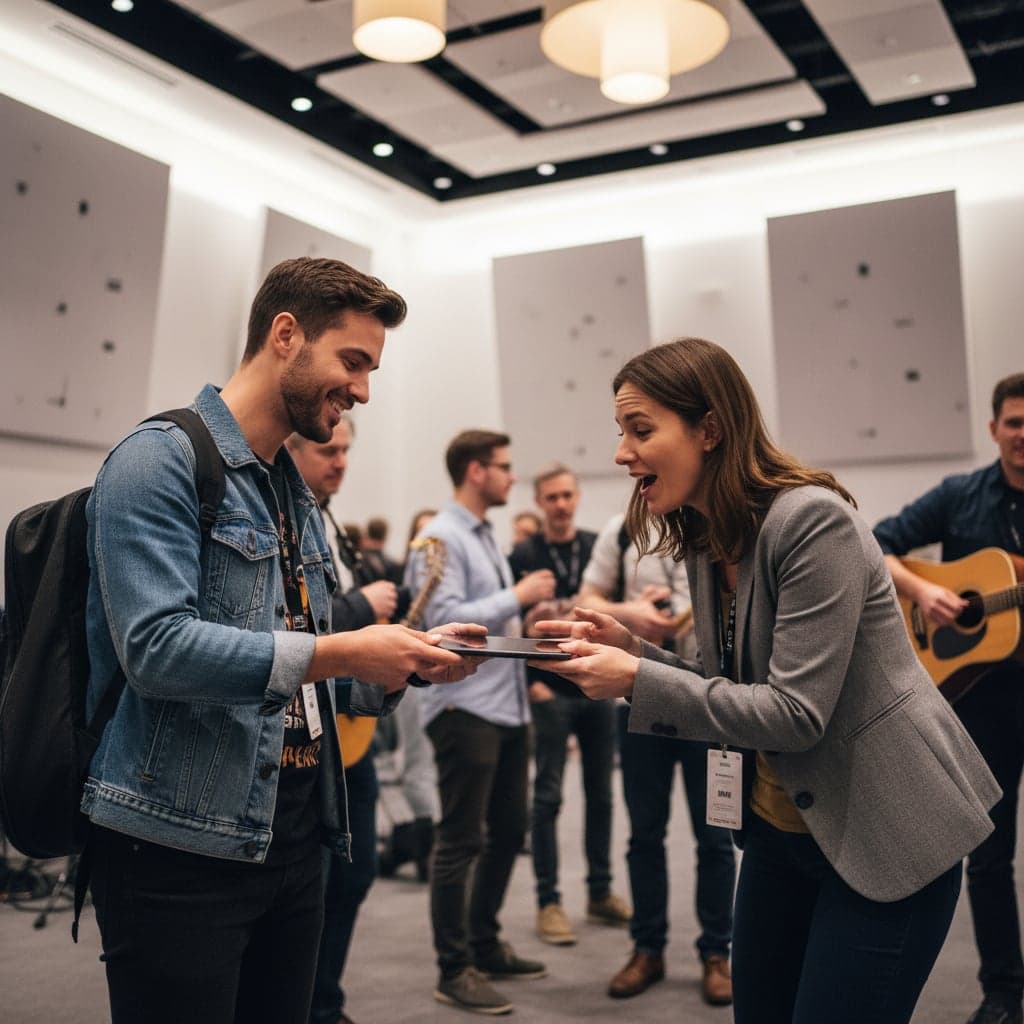
A great EPK doesn't work if it just sits there. You have to put it in front of the right people, the right way.
Sending Your EPK to Venues and Promoters
When you pitch a venue or promoter, your email should be brief and to the point. Introduce yourself, state why you're a good fit for their venue, and then provide a clear link to your EPK. Don't attach large files; always link to your live EPK page. A common mistake is sending a generic email. Instead, mention a specific show you saw there, or an artist they've hosted that you admire.
For example, instead of "Hey, check out my band," try: "Hi [Venue Booker Name], I saw [Artist Name] play at your venue last month and loved the vibe. My band, [Your Band Name], plays a similar blend of [genre 1] and [genre 2] with high-energy live shows. I think we'd be a great fit for your [specific night/type of event]. You can hear our music and see our live video here: [Link to EPK]." Make it easy for them to say yes.
Pitching Media and Playlisters with Your EPK
Pitching to blogs, journalists, and playlist curators requires a slightly different approach. They're looking for a story, something newsworthy, or music that fits their specific niche. Your email should highlight your unique story, a recent achievement, or a compelling angle about your new release. Then, link to your EPK.
Be specific about what you're asking for. "I'm reaching out because our new single, '[Song Title]', has a unique story about [brief story]. I think it's a strong fit for your readers at [Blog Name/Playlist Name]. You can listen to it and find more info in our EPK: [Link to EPK]." Always follow up once, usually a week after your initial email, if you don't hear back. For more advice on this, articles like the one from
and this piece from
offer valuable insights into effective outreach.
Frequently Asked Questions About Electronic Press Kits
How long should an EPK be for independent musicians?
An EPK should be concise and easily digestible, typically fitting on one scrollable page or a few well-organized tabs. The goal is to provide all necessary information without overwhelming the viewer, allowing them to quickly find what they need.
What is the single most important element to include in my EPK?
Your music is the most important element, since it's the core of what you do. However, a compelling and concise artist bio that immediately grabs attention is a close second, as it provides context and tells your story quickly.
Do I need a separate website for my EPK, or can it be a PDF?
While a PDF can work in a pinch, a dedicated web page for your EPK is far more professional and effective. It allows for embedded players, videos, and analytics, making it more interactive and trackable than a static PDF.
How often should I update my electronic press kit?
You should update your EPK whenever there's significant news, like a new release, major press mention, or important performance. At a minimum, review it every 3-6 months to ensure all information, links, and media are current and working correctly.